.svg)
Practical guidance on lumen targets, IP ratings, color temperature, CRI, placement, and smart controls for safe, efficient parking lot LED lighting.

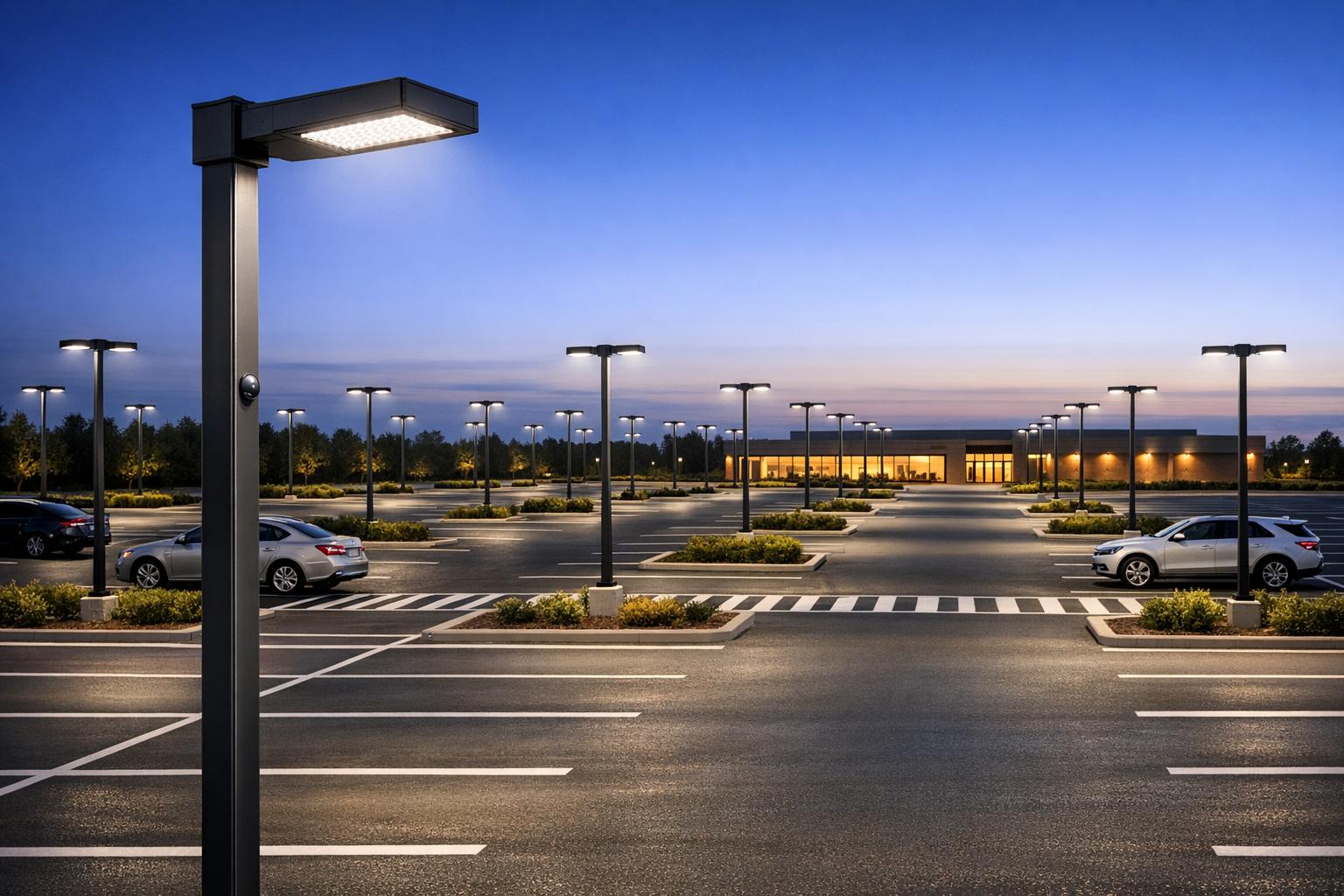
When it comes to outdoor parking, LED fixtures are the top choice for energy efficiency, durability, and safety. They use up to 75% less energy than older systems, last 50,000–100,000 hours, and provide consistent, bright illumination without dark spots. Here's what you need to know to pick the right ones:
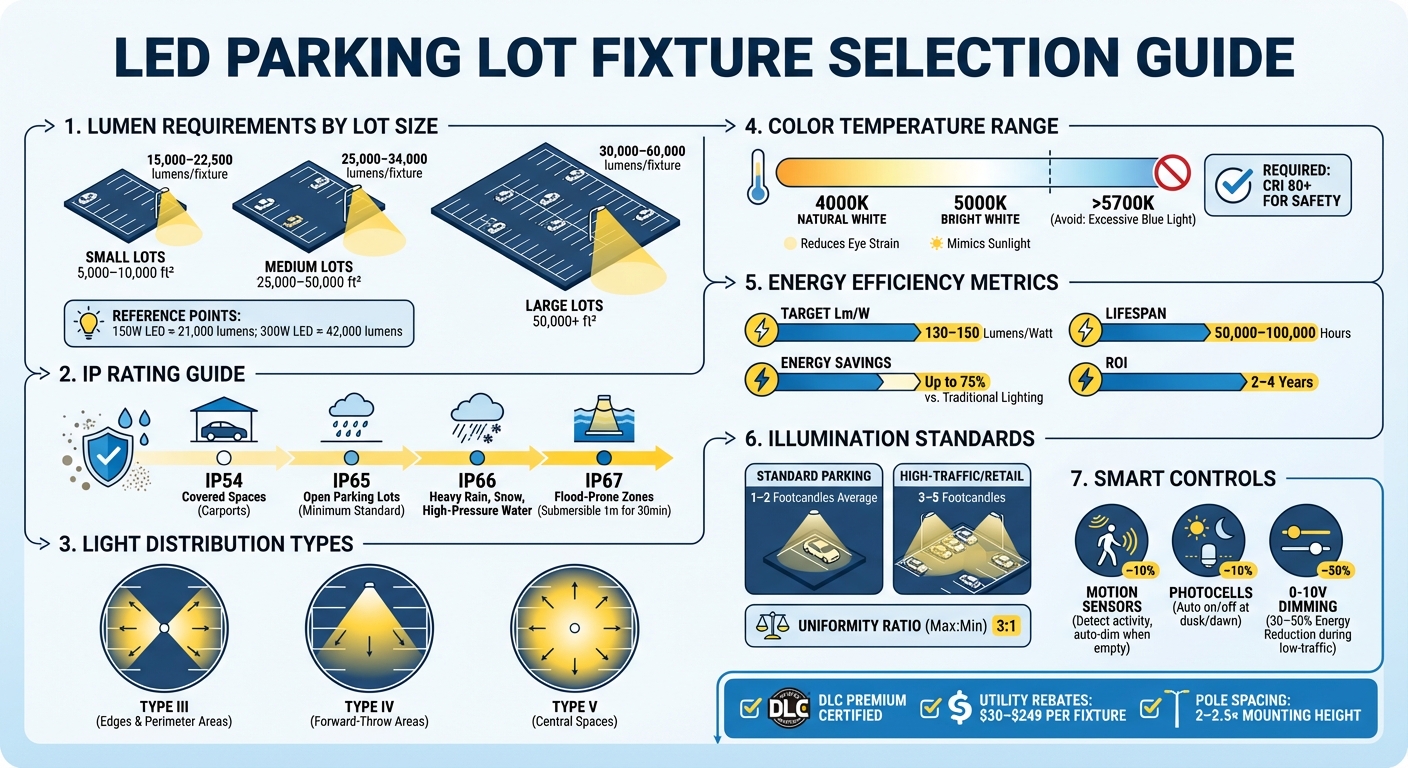
LED Parking Lot Fixture Selection Guide: Lumens, IP Ratings, and Specifications
When planning lighting for a parking lot, it's essential to calculate the required lumens based on the lot's size and purpose.
For context, a 150W LED fixture typically generates about 21,000 lumens, while a 300W fixture produces around 42,000 lumens.
Areas with high foot or vehicle traffic, such as entrances and walkways, generally require at least 30,000 lumens for safety. In contrast, low-traffic zones can function well with 15,000–20,000 lumens. According to IESNA standards, parking lots should maintain an average illumination of 1–2 foot-candles, while high-traffic or retail areas need 3–5 foot-candles. To ensure balanced lighting, aim for a uniformity ratio of 3:1, meaning the brightest spots should not be more than three times brighter than the dimmest areas.
These guidelines help determine the number of fixtures and their placement to achieve consistent and safe lighting.
Proper fixture placement is just as important as lumen output for achieving balanced lighting. Even distribution prevents dark spots and reduces overlaps, ensuring a safer and more visually appealing environment.
A common rule of thumb is to space light poles at 2 to 2.5 times their mounting height. For instance, poles mounted at 25 feet should be spaced approximately 50–60 feet apart.
The height of the poles also plays a significant role in coverage. Taller poles (25–40 feet) spread light over a larger area, reducing the number of fixtures needed. Shorter poles (12–20 feet) provide more focused lighting, making them ideal for smaller retail spaces or areas near residential properties where minimizing light spill is a priority.
For the most precise results, a photometric study is highly recommended. This type of analysis models light levels, average and minimum illumination, and uniformity ratios before installation. It helps avoid common pitfalls like over-lighting, which wastes energy, or under-lighting, which compromises safety.
Modern LED fixtures can deliver up to 170 lumens per watt, so choosing fixtures rated at 130 lumens per watt or higher ensures both energy efficiency and effective lighting. Thoughtful placement not only enhances safety but also optimizes energy consumption.
IP ratings measure how well a fixture is protected against dust and water, as established by IEC standards. The first digit (ranging from 0 to 6) indicates protection against solids like dust, with 6 meaning completely dust-tight. The second digit (ranging from 0 to 9) reflects the level of water resistance.
For open parking lots, a minimum of IP65 is recommended. Without adequate protection, water can infiltrate fixtures, leading to failures within just 2–4 years in wet climates.
In harsher conditions - like areas with heavy rain, snow, or maintenance crews using high-pressure water - IP66 is a better choice, as it can withstand powerful water jets. For zones prone to temporary flooding or standing water, such as in-ground lights or low-lying areas, IP67 is essential. This rating allows the fixture to be submerged in up to 1 meter of water for 30 minutes. Match the IP rating to the specific conditions of your parking area: use IP54 for covered spaces like carports, IP65 for fully exposed poles or wall-mounted lights, and IP67 for flood-prone zones.
However, IP ratings alone aren’t enough - materials and construction also play a major role in a fixture's durability.
The materials used in a fixture significantly affect its ability to withstand outdoor conditions over time. Die-cast aluminum housings are a top choice due to their sturdiness, efficient heat dissipation, and resistance to corrosion. A specialized powder coating further enhances their ability to endure harsh environments. In coastal or snowy regions, stainless steel hardware is a must to combat rust caused by salt exposure and UV rays.
Silicone gaskets and rubber seals are critical for maintaining the fixture's IP rating, but they can wear down over time from UV exposure and temperature shifts. Inspect these components every 3–5 years for signs of cracking or hardening. Additionally, avoid using high-pressure washers on fixtures unless they are rated IP69K, as the intense pressure can compromise the seals of standard IP65 or IP67 fixtures. Proper orientation of fixtures to allow water drainage and sealing all cable entry points are also key steps to maintaining their protective qualities.
"The IP rating of a light is useless if it is not installed properly. Read the instructions, seal cable entry points tightly, and orient the fixture so that water will drain off freely." – NGFung Kwan, Author, Hyperlite
When lighting parking areas, selecting the right color temperature is essential for ensuring both brightness and safety. For outdoor parking lots, the ideal range is 4000K to 5000K. This range provides a neutral white light that enhances visibility without causing harsh glare.
It’s important to avoid mixing color temperatures in the same area. For example, using both 3000K and 5000K fixtures can create visual discomfort and an inconsistent look. Additionally, staying below 5700K is recommended to minimize glare and avoid disrupting circadian rhythms. The American Medical Association advises against outdoor lighting above this threshold due to the high blue-light content, which can interfere with sleep patterns. By choosing the right color temperature, drivers can see more clearly, especially when paired with proper color rendering.
The Color Rendering Index (CRI) is a measure of how accurately a light source displays the true colors of objects. It’s scored on a scale from 0 to 100, with 100 representing the color accuracy of natural sunlight. For parking lots, a CRI of 80 or higher is essential for safety. High CRI lighting ensures drivers and pedestrians can accurately distinguish vehicle colors, read signage, and spot hazards like spilled liquids.
Lights with a CRI below 70 can distort colors, such as turning a red stop sign into an orange one. Modern LED fixtures typically have CRI ratings of 80 or higher, while older HID (High-Intensity Discharge) lights often have much lower CRI values, sometimes below 50. In fact, regulations like California’s Title 24 now require a minimum CRI of 80+ and an R9 score (red color rendering) of at least 50.
"For parking lots, a higher CRI enhances safety by making it easier to distinguish colors - critical for identifying hazards like spilled liquids, clothing, or even vehicle signals." – Demilare
It’s also worth noting that CRI is separate from color temperature. For example, a light can have a cool appearance (5000K) but still perform poorly in color rendering if its CRI is low. Fortunately, LEDs in the 4000K to 5000K range often come with high CRI ratings, making them an excellent choice for parking facilities. They not only improve visibility but also align with energy efficiency and safety priorities.
Once durability and proper lighting are ensured, the next step is focusing on energy performance and cost savings. Choosing weather-resistant LED fixtures that deliver on both efficiency and affordability is essential.
A key metric to evaluate is lumens per watt (lm/W) - this measures how much light a fixture produces per watt of energy consumed. High-quality LED parking lot fixtures typically achieve 130–150 lm/W. This is about twice as efficient as older metal halide systems (60–90 lm/W) and on par with high-pressure sodium lights (80–140 lm/W).
When upgrading, match the light output (lumens), not the wattage. For instance, a 300W LED fixture can replace a 1,000W metal halide fixture while delivering the same brightness. Many modern LED fixtures also feature field-selectable wattage, allowing users to adjust energy consumption and brightness during installation. Additionally, look for fixtures with an L70 rating of 50,000 to 100,000 hours, which ensures the fixture retains at least 70% of its brightness over its lifespan, cutting down on replacement costs.
Certifications like DLC Premium and UL listings confirm performance and often make fixtures eligible for utility rebates. Switching to LEDs can slash energy use by at least 75%, and since lighting accounts for roughly 17% of electricity consumption in U.S. commercial buildings, these savings add up fast. Most facilities recover their investment in LEDs within 2 to 4 years.
These metrics not only impact energy savings but also determine eligibility for utility incentives, making them a vital consideration.
Utility rebates in the U.S. can significantly lower the upfront costs of LED upgrades. Prescriptive rebates offer fixed amounts, typically ranging from $30 to $100 per fixture, while custom rebates are calculated based on total energy savings in kilowatt-hours (kWh). In some cases, rebates can save up to $249 per fixture, often covering 20% to 40% of the total cost.
To qualify for these rebates, fixtures must be listed on the DesignLights Consortium (DLC) Qualified Products List (QPL). Opting for "DLC Premium" fixtures instead of "DLC Standard" can unlock rebate tiers that are 20–50% higher. Be sure to apply for rebates before installation, as most programs require pre-approval to secure funding. For a comprehensive view of available incentives, the DSIRE (Database of State Incentives for Renewables & Efficiency) can be cross-referenced with local utility programs.
In addition to rebates, installing smart lighting controls - like 0–10V dimming, motion sensors, and photocells - can cut energy use by an extra 20–40% during low-occupancy periods. These controls may qualify for additional incentives. Commercial property owners can also benefit from the 179D tax deduction for energy-efficient lighting upgrades. Conducting an energy audit is another valuable step to calculate current energy use versus projected savings, which is often necessary for custom rebate applications.
Smart controls take energy-efficient LED fixtures to the next level, boosting both safety and functionality in outdoor parking areas. By integrating these controls, energy use can drop by 30%–50% during low-traffic times. Here's how some key features work:
Take the example of a Chicago shopping center that, in April 2025, switched to 300W LED fixtures with 5000K cold white light and motion sensors. The upgrade improved security camera recognition rates from 68% to 94% and reduced theft and vandalism by 37% in just six months by eliminating blind spots. Similarly, a Pittsburgh hospital installed fixtures with microwave motion sensors that boosted brightness to 100% within 0.2 seconds of detecting movement. This upgrade cut false alarms by 57%. These cases highlight how smart controls can enhance both security and energy efficiency.
Advanced systems like DALI and Zigbee add another layer of functionality. DALI supports up to 64 individually addressable devices per segment, making it perfect for large-scale installations. Wireless options like Zigbee are great for retrofit projects, as they eliminate the need for additional wiring. These technologies not only improve energy management but also help meet strict local lighting regulations.
Keeping up with local lighting standards is easier - and more cost-effective - with smart controls. For instance, the 2023 update to IES RP-8 requires open parking lots to maintain an average illumination of 0.5 to 1.0 footcandles (fc), with high-crime areas needing 2.0 fc or more. Adaptive dimming and programmable schedules help ensure compliance with these rules while also adhering to dark-sky ordinances.
"A poorly lit lot is a lawsuit waiting to happen. Documented compliance with current standards is your best defense." – light.rackorapro.com
Energy codes like ASHRAE 90.1 and California's Title 24 also require features like occupancy sensors and demand response capabilities. Photometric studies are key to verifying that the layout meets the 4:1 average-to-minimum uniformity ratio. Additionally, choosing DLC Premium-certified fixtures ensures eligibility for utility rebates and compliance with efficiency standards.
For critical facilities, such as hospitals or municipal parking lots, fixtures with integrated emergency power are essential. These meet NFPA 110 Level 1 compliance by switching to backup power within 0.5 seconds, ensuring uninterrupted safety and functionality.
Choosing LED fixtures for outdoor parking involves finding the right balance between performance, durability, and cost. Most LED fixtures provide between 17,000 and 51,000 lumens with an efficacy of at least 130 lm/W, which translates to significant energy savings. Proper placement is crucial to achieve even lighting coverage and avoid dark spots.
Look for fixtures with at least an IP65 rating to protect against dust and water. For areas exposed to extreme weather or high-pressure cleaning, consider upgrading to IP66-rated fixtures. These features ensure durability in challenging conditions.
For visibility, aim for a color temperature between 4000K and 5000K. This range offers bright, neutral white light that improves visibility and works well with camera systems, all while minimizing glare. Adding smart controls - like 0–10V dimming, motion sensors, and photocells - allows for efficient energy use during low-traffic times and extends the lifespan of the fixtures. LEDs typically last 50,000 to 100,000 hours, consume 75% less electricity, and provide a return on investment within 2–4 years.
By focusing on these factors, you can improve safety, reduce costs, and meet energy compliance standards in outdoor parking areas.

Upgrading your lighting system doesn’t have to be complicated. Luminate Lighting Group can guide you through the process.
From calculating lumens to understanding IP ratings and local energy codes, the details can feel overwhelming. Luminate Lighting Group specializes in custom lighting solutions and energy-efficient LED retrofits for parking lots and garages. Their team performs photometric studies to ensure even coverage and helps you qualify for utility rebates and 179D tax deductions. Whether you're retrofitting an existing lot or designing a new one, they offer turnkey installations that prioritize performance, durability, and long-term savings.
Visit luminatelightinggroup.com to schedule a consultation and energy audit.
When determining how many LED fixtures you need for a parking lot, you'll want to consider the lot's size, the level of brightness you're aiming for, and the efficiency of the fixtures you plan to use. Start by figuring out the total lumens required for the area. Once you have that number, divide it by the lumen output of the fixtures you've selected.
To achieve consistent and even lighting, pay attention to how the fixtures are laid out and the spacing between poles. Using photometric tools or getting advice from a lighting professional can be invaluable for ensuring proper placement and avoiding areas that are too dim.
A photometric study isn't required, but it's a smart move if you want to ensure your lighting setup works as it should. This kind of study helps figure out the best fixtures, their placement, and the right lighting levels to meet safety standards and regulations - especially in larger or more complicated parking lots. By analyzing details like lumen output and beam spread, it can help you avoid issues like over-lighting or under-lighting, which can save both time and money down the line.
When it comes to cutting energy use in parking lots, occupancy sensors and daylight sensors are top choices. These smart devices adjust lighting based on real-time needs - whether that's the presence of people or the amount of natural light available.
For example, occupancy sensors can dim or completely turn off lights in areas that aren't being used, leading to an impressive 20–40% reduction in energy use. When you combine these sensors with vapor-tight LED fixtures and sensor-ready drivers, the result is even greater efficiency and control, making them a winning combination for energy-conscious parking lot lighting.


