.svg)
IECC C405.2 requires occupancy sensors, automatic shutoffs, daylight dimming, manual overrides and LLLC options for commercial lighting.

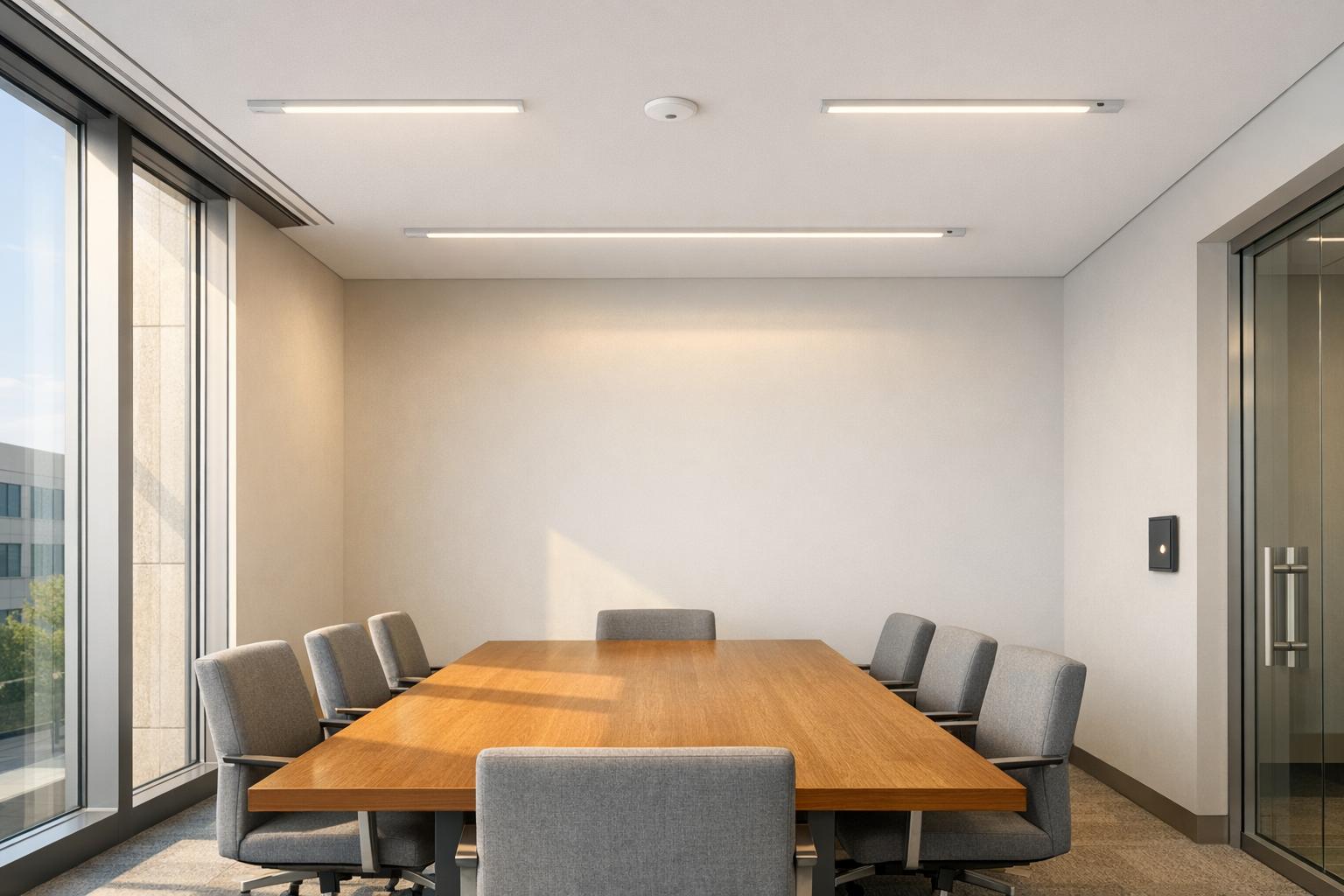
Lighting controls are a must for commercial buildings. Section C405.2 of the IECC sets clear rules to ensure lighting is used efficiently, saving energy and cutting costs. Here's what you need to know:
For compliance, you can follow these requirements or opt for Luminaire-Level Lighting Controls (LLLC), which integrate sensors directly into fixtures for advanced functionality. These rules apply to all commercial projects, from offices to warehouses.

IECC Section C405.2 Lighting Control Requirements Overview

Section C405.2 outlines three key lighting control requirements: automatic shutoff systems, occupancy sensors, and daylight-responsive controls. These measures aim to reduce unnecessary energy usage by ensuring lighting systems operate efficiently based on occupancy and available daylight.
Lighting systems must automatically turn off when spaces are unoccupied. This can be achieved through either occupancy sensors or time-switch controls. Time-switch systems must include:
Additionally, a manual override is required, but it should be limited to a 2-hour duration. Control areas cannot exceed 5,000 square feet, and the system must allow for a uniform 50% reduction in lighting where applicable.
Occupancy sensors, which build on automatic shutoff protocols, are mandatory in various spaces such as classrooms, conference rooms, offices, restrooms, storage areas, and warehouses. These sensors must ensure lights turn off within 20 minutes of the space being vacated.
The controls for these sensors can be set to either "manual-on" or an automatic-on mode capped at 50% of full power. Exceptions are made for public corridors, stairways, and restrooms, where full automatic-on functionality is permitted for safety reasons.
In open-plan offices larger than 300 square feet, lighting circuits must be divided into zones no larger than 600 square feet. When a zone is unoccupied, general lighting power must be reduced by at least 80% within 20 minutes. For warehouse aisles, each aisle must have independent controls that reduce power by 50% when not in use.
Daylight-responsive controls adjust lighting based on the amount of natural light available, further enhancing energy efficiency. These controls are required in spaces where general lighting power exceeds specific thresholds:
These controls must allow for continuous dimming from 100% to 15% and completely shut off lights when adequate daylight is present. Additional requirements include:
Calibration mechanisms must be accessible within the controlled space, and time-delay circuits must be used to prevent light-level cycling of less than three minutes.
Some lighting setups - like display, accent, and task lighting - require their own dedicated controls. For example, display cases or under-cabinet task lights must be managed using either an occupant sensor or a time-switch to ensure proper usage and energy efficiency.
For nonvisual lighting, such as systems used for plant growth or food warming, an independent time-switch is mandatory. This ensures that these specialized systems aren't accidentally turned off by occupancy sensors or general schedules, which could disrupt their specific functions.
In sleeping units, any permanently installed lights or switched outlets must automatically turn off within 20 minutes of the space being vacated. However, there are exceptions for areas where patient care is provided or where card key systems are in place to manage lighting. These guidelines ensure precise control while accommodating specific needs.
Even in areas with automatic lighting controls, Section C405.2 requires that occupants have the ability to manually adjust their lighting. These manual controls must allow for a 50% reduction in lighting load, achieved through methods like:
For spaces managed by time-switches, a manual override must be available for use beyond scheduled hours. These overrides are capped at 2 hours for spaces up to 5,000 square feet. Larger areas, up to 20,000 square feet, can exceed this limit if a captive key device is used.
Manual controls must be placed within or clearly associated with the area they serve. Additionally, they need to include indicators that display the current lighting status, making it easy for users to understand and manage their lighting settings.
Just like interior lighting, exterior lighting systems are designed to use automation for better energy efficiency. Outdoor lighting must automatically turn off when there’s enough natural daylight. This rule covers all lighting connected to the building's energy supply, including site lighting around the property.
For facade and landscape lighting, there are specific timing rules: these lights must shut off automatically for at least six hours each night. Alternatively, they can be programmed to turn off within an hour after closing and come back on no earlier than an hour before opening - whichever timeframe is shorter. Time-switch controls used for outdoor lighting must feature a 7-day programmable clock, a holiday setback option, and a backup system that can retain settings for at least 10 hours during power outages.
However, areas designated for emergencies or safety-critical purposes are exempt from these automatic shutoff requirements. In addition to complete shutoff, some outdoor areas also need to reduce power during periods of low activity.
In certain outdoor spaces, lighting must dim during times of low activity. For example, lighting in areas like warehouse aisleways or corridors must reduce power to 50% within 20 minutes of detecting vacancy. This ensures that while lights remain on for safety, they operate at a lower intensity to conserve energy.
Not every space adheres to the same lighting control rules. Some areas are granted exemptions or alternative compliance options due to their unique requirements. For example, security and emergency zones that need continuous lighting are exempt, as are interior exit routes typically not in use.
In health care facilities, automatic time-switch controls, daylight-responsive systems, and specific application controls are not required in sleeping units. This ensures that patient care remains uninterrupted.
While manual-on or 50% auto-on functionality is standard, full automatic-on controls are allowed in spaces like public corridors, stairways, restrooms, main building entrances, and lobbies - areas where manual controls could pose risks to safety or security. Additionally, light-reduction controls are not necessary in smaller areas, such as when a single luminaire rated under 100 watts is present, or in spaces like corridors, lobbies, and mechanical or electrical rooms.
Certain first-floor sidelit zones in Group A-2 (assembly/dining) and Group M (mercantile) occupancies are also exempt from daylight-responsive control requirements. These exceptions are made to balance energy code compliance with the specific operational demands of these spaces.
For projects seeking an integrated approach, Luminaire-Level Lighting Controls (LLLC) provide a streamlined alternative. Section C405.2 outlines how LLLC systems can meet energy standards effectively. These systems incorporate occupancy and daylight sensors directly into each light fixture, simplifying the design process.
To comply, each LLLC fixture must independently detect occupant movement and ambient light levels - both natural and artificial. The system must then automatically adjust lighting and allow customization of settings like dimming rates, timeouts, and sensor sensitivity. Additionally, LLLC systems must support wireless zoning for greater flexibility.
Even with LLLC, installations must still include manual controls as specified in Section C405.2.5. Specific application controls, such as those for display or task lighting, are also required. In open-plan offices, LLLC systems should group fixtures into zones no larger than 600 square feet. Within 20 minutes of a zone being vacated, general lighting power must reduce by at least 80%.
Section C405.2 sets clear guidelines for lighting controls aimed at significantly reducing energy consumption and operating expenses. For example, warehouses are required to cut lighting by 50%, while open-plan offices must achieve an 80% reduction. Additionally, occupancy sensors must switch off lights within 20 minutes of detecting inactivity.
Compliance can be achieved through traditional sensor and switch systems or more advanced integrated LLLC (Luminaire-Level Lighting Control) solutions.
Key technical requirements include features like continuous dimming down to 15%, a 10-hour backup for time-switch devices, and 2-hour manual override capabilities. These elements demand precise calibration to avoid potential errors that could lead to unnecessary expenses.
Partnering with industry experts can help ensure compliance with these codes while maximizing energy efficiency and unlocking financial benefits like utility rebates and 179D tax credits. Luminate Lighting Group offers customized LED solutions for various environments - including warehouses, offices, industrial facilities, and municipal spaces. Their services cover everything from photometric layouts and control system specifications to securing rebates and tax incentives.
Occupancy sensors are necessary in restrooms, enclosed offices, open-plan office areas, corridors, storage rooms, locker rooms, and any spaces that are 300 square feet or smaller and enclosed by floor-to-ceiling partitions. These sensors play a key role in meeting energy code requirements by automatically managing lighting usage.
Luminaire-Level Lighting Controls (LLLC) can help you meet the requirements of C405.2, provided they are set up to:
Additionally, these controls must comply with the standards for independent luminaire control.
Exceptions apply to specific spaces within healthcare facilities where direct patient care occurs, as well as certain sidelit daylight zones on the first floor in Group A-2 and Group M occupancies. For these daylight zones, they must be adjacent to outdoor pedestrian areas, and their light fixtures need to have controls that operate independently from the general area lighting.


