.svg)
Match LED fixtures to temperature, IP sealing, NSF washdown, and mounting height for reliable cold-storage lighting.
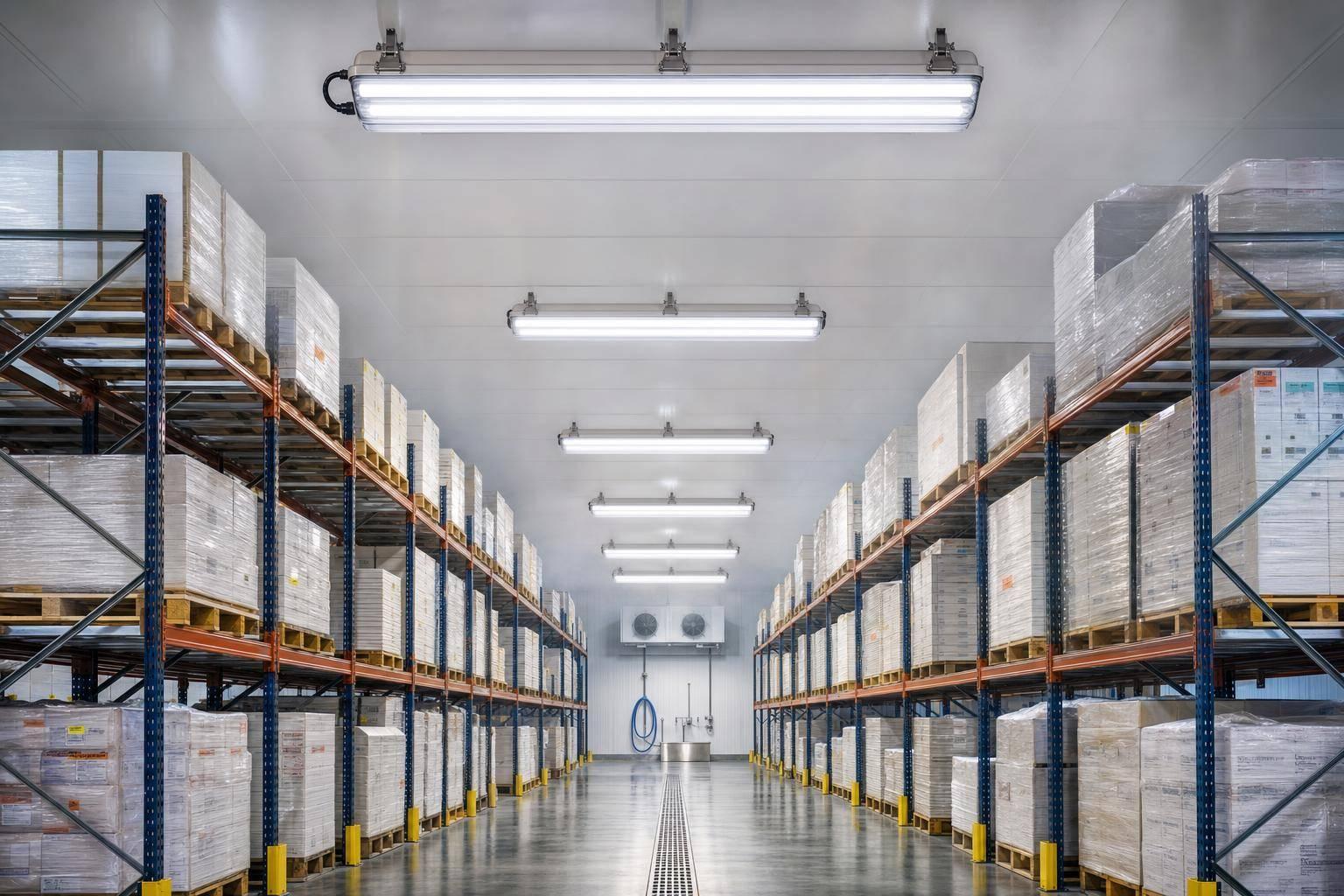
Cold storage lighting fails fast when the fixture does not match the room. If I were choosing lights for a cooler, freezer, or washdown area, I’d check four things first: low-temp rating, IP sealing, food-safety approval, and fixture shape for the space.
Here’s the short version:
A few numbers make the case clear. Standard fluorescent fixtures can fall to 25% of rated output at 14°F, while many LEDs keep steady output down to -40°F. LEDs also last 50,000+ hours in many cases, compared with roughly 8,000 to 15,000 hours for fluorescent tubes. That means fewer replacements, less labor, and less disruption in cold rooms.
The fixture list in this article covers 10 options and fixture types, including:
If I had to boil the whole article down to one line, it would be this: match the fixture to the temperature, moisture, cleaning method, and mounting height - or pay more later.
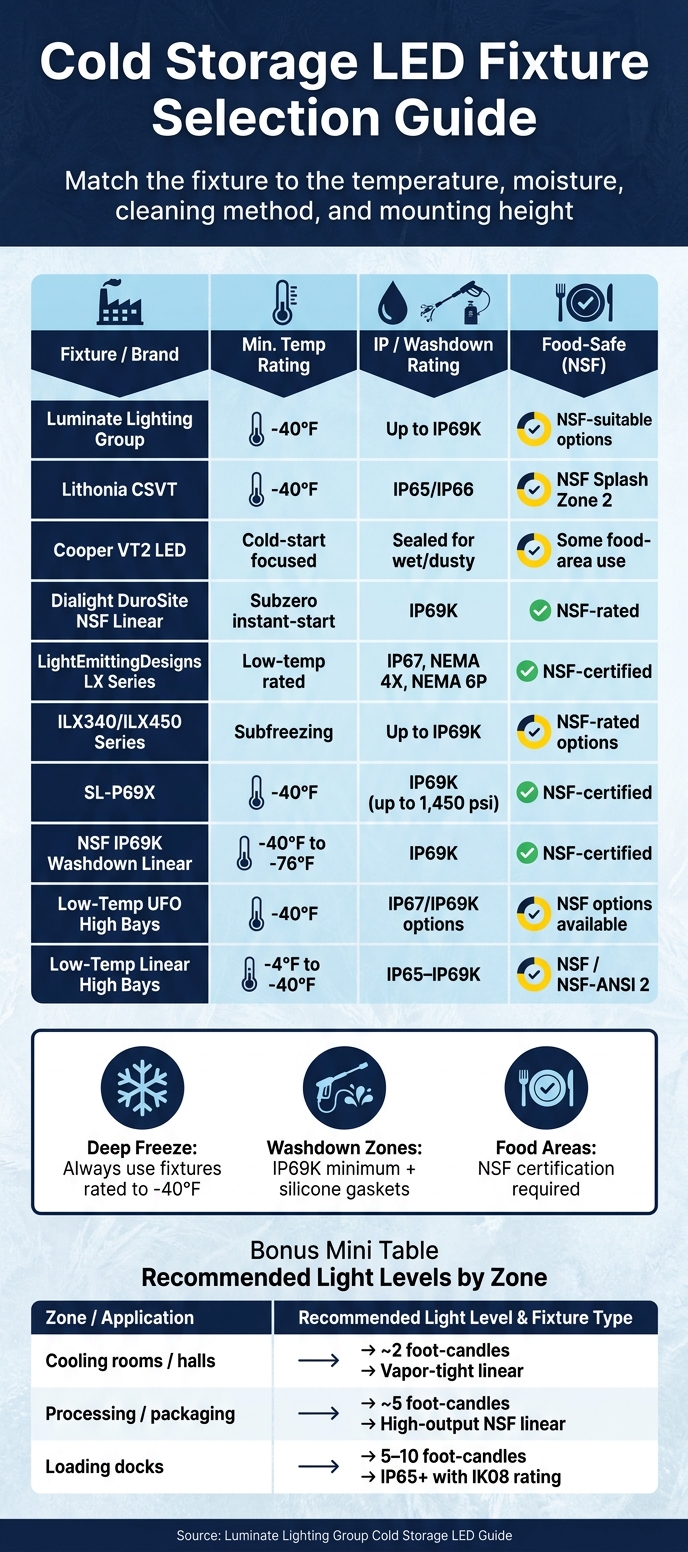
Cold Storage LED Fixture Comparison: IP Rating, Temp & NSF Guide
| Option | Best Fit | Low-Temp Use | Sealing / Washdown | Food Area Use |
|---|---|---|---|---|
| Luminate Lighting Group | Multi-zone retrofits | -40°F | Up to IP69K | NSF-suitable options |
| Lithonia CSVT | Coolers, prep, low/mid height spaces | -40°F | IP65/IP66 | NSF Splash Zone 2 |
| Cooper VT2 LED | Cold rooms, wet cleanup areas | Cold-start focused | Sealed for wet/dusty areas | Some food-area use |
| Dialight DuroSite NSF Linear | Food processing, deep-freeze | Subzero startup | IP69K | NSF-rated |
| LightEmittingDesigns LX | Condensation-heavy cold rooms | Low-temp use | IP67, NEMA 4X, NEMA 6P | NSF-certified |
| ILX340/ILX450 | Freezer aisles, warehouses, washdown | Subfreezing use | Up to IP69K | NSF-rated options |
| SL-P69X | Food plants with frequent washdown | -40°F | IP69K | NSF-certified |
| NSF IP69K Washdown Linear | Meat, dairy, seafood, beverage plants | -40°F to -76°F on some models | IP69K | NSF-certified |
| Low-Temp UFO High Bays | Open cold warehouses | -40°F | IP67/IP69K options | NSF options available |
| Low-Temp Linear High Bays | Tall racks and aisles | -4°F to -40°F | IP65–IP69K | NSF / NSF-ANSI 2 options |
The rest of the article helps you sort out which one fits your room, cleaning routine, and ceiling height.
A fixture that works fine in a dry warehouse can fail fast in a blast freezer. Lenses fog up. Gaskets crack. Drivers start to flicker. That’s why it pays to check a few things before you buy.
Start with the temperature rating. Standard cold-storage fixtures should be rated for at least −4°F to 122°F. Deep-freeze and blast-chill areas need fixtures made for much lower temperatures. It also helps to check the driver for solid cold-start performance. If the driver struggles at startup, the whole fixture can become a headache.
A sealed housing is a big deal. A lot of cold-storage failures begin with thermal shock: warm, humid air hits a cold fixture, and condensation forms almost at once. That moisture can sneak into weak points and cause problems over time. For general cold storage, IP65 is the starting point. In freezer rooms or areas with heavy condensation, move up to IP66. In food processing spaces that need high-pressure washdowns, use IP69K. In subzero conditions, silicone gaskets are the safer pick because standard rubber can harden and lose its seal.
NSF certification matters in food areas. If a fixture sits near food production or packaging, it should be NSF-certified. That helps confirm the materials are food-safe and that the fixture is built for washdown use, without exposed screws or small crevices where bacteria can collect. In washdown zones or places with lots of condensation, pair NSF certification with a wet-location rating.
Light levels should fit the space. Not every room in a cold storage building needs the same output. A hallway has one job. A packaging line has another. Here’s a quick reference:
| Zone | Target Light Level | Typical Fixture |
|---|---|---|
| Cooling rooms / halls | ~2 foot-candles | Vapor-tight linear |
| Processing / packaging | ~5 foot-candles | High-output linear, NSF-rated |
| Loading docks | 5–10 foot-candles | IP65+ with IK08 rating |
For taller spaces, LED high bays in the 88W to 176W range - about 13,000 to 26,600 lumens - are a practical fit. Walk-in coolers with lower ceilings can often use 20W to 35W fixtures that produce 2,000 to 3,500 lumens. One small but important tip: ask for system efficacy, not chip efficacy. That gives you a better picture of how the full fixture will perform in the field.
Use these filters to match each fixture below to the right room, ceiling height, and sanitation level. The options below are grouped by how well they meet those needs.
Luminate Lighting Group designs retrofits for cold rooms, washdown areas, and food-handling spaces based on the requirements above. The company offers custom LED retrofits for freezers, coolers, and food-processing areas, with fixture selection tied to temperature, sanitation, and layout needs. That makes Luminate a good match for facilities that need solid performance in harsh conditions and help with retrofit planning.
Luminate specifies fixtures rated to −40°F for reliable startup and steady output in subzero spaces.
For washdown zones, Luminate specifies IP69K fixtures with sealed housings to handle high-pressure cleaning and condensation.
For food production and packaging areas, Luminate uses NSF-suitable fixtures with smooth, easy-to-clean housings.
Retrofit options include sealed linear fixtures and high bays for cold-storage retrofits, along with support for code compliance, rebates, and 179D deductions.
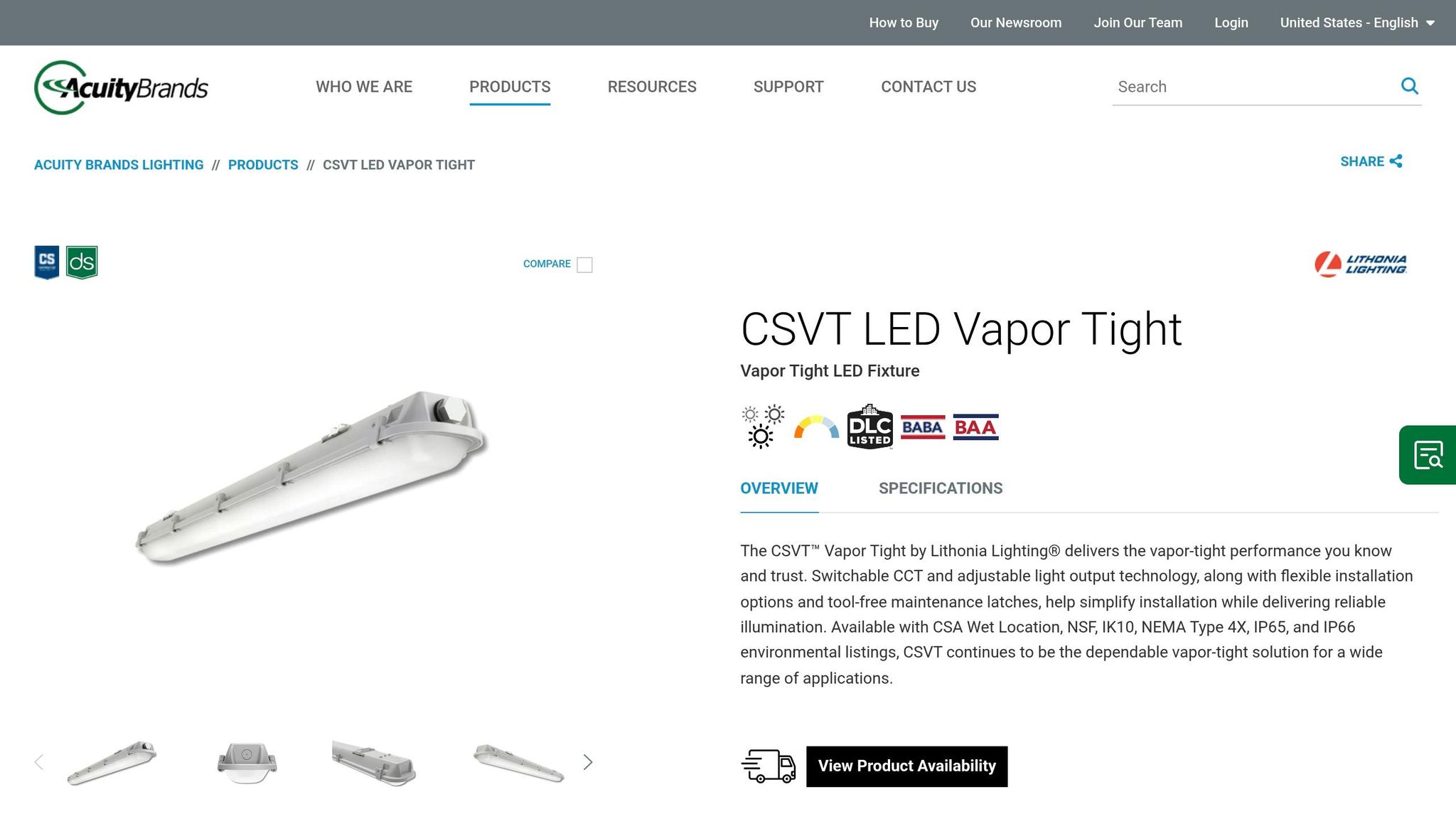
If you need a standard vapor-tight retrofit without extra bells and whistles, the Lithonia Lighting CSVT checks the main boxes for cold storage. It's a sealed LED fixture made for cold storage, washdown spaces, and dusty areas. In plain English: it works well for sites that need sealed housing, dependable cold starts, and basic food-area compliance.
The CSVT is rated for a minimum operating temperature of −40°F. That makes it a solid fit for deep-freeze conditions.
With IP65/IP66 sealing, the fixture is protected against dust, moisture, and low-pressure washdowns. That's a good match for coolers and cold storage rooms where regular cleaning is part of the day-to-day work.
The fixture carries NSF Splash Zone 2 certification, which fits food-handling areas outside direct food-contact zones.
The CSVT works best at low to mid mounting heights in walk-in coolers, refrigerated warehouses, and cold prep areas.
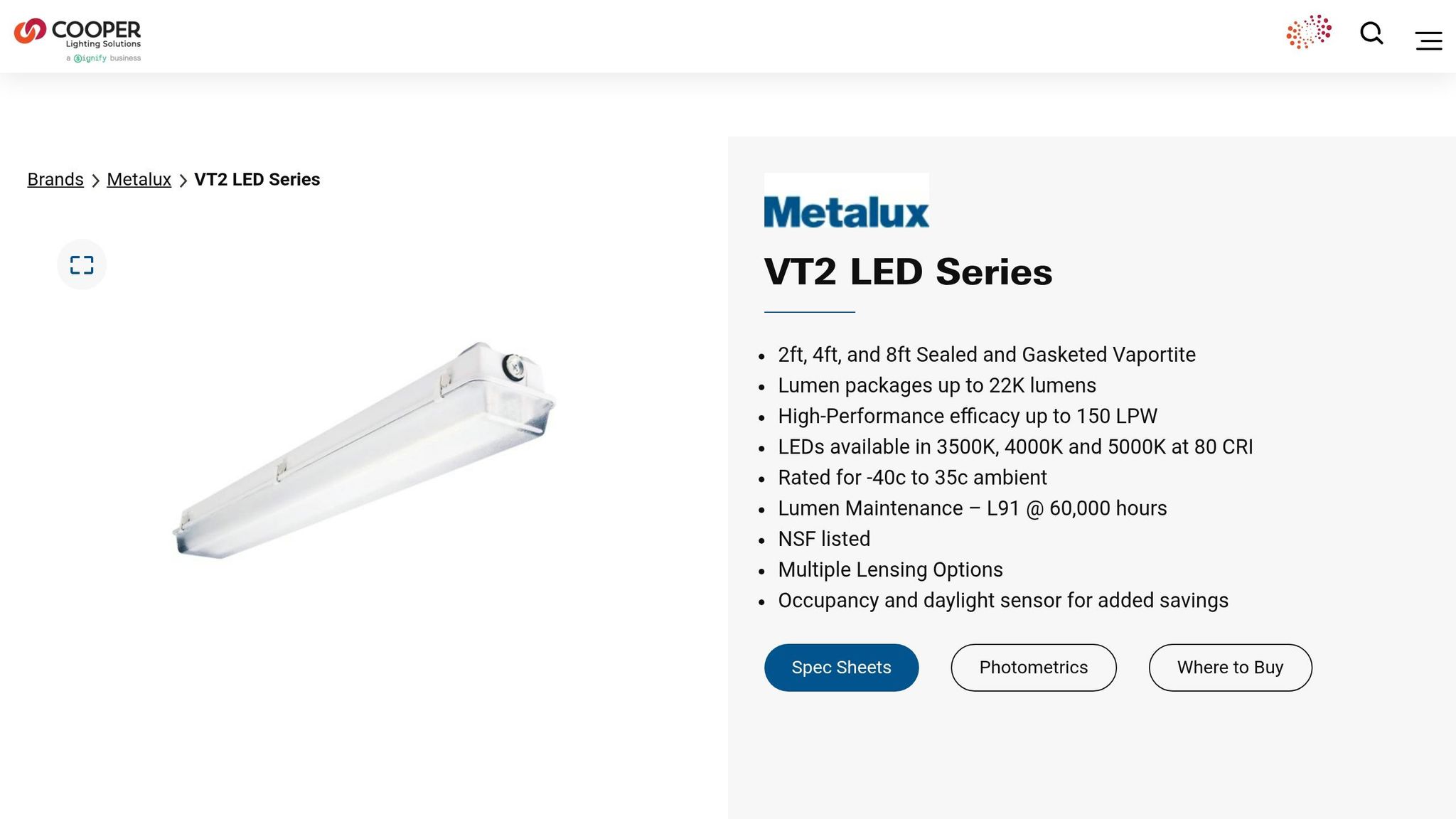
The Cooper Lighting Metalux Vaportite VT2 LED is a sealed, vapor-tight fixture built for cold rooms, refrigerated warehouses, and spaces that get wet during cleanup.
It’s a solid fit for places like ingredient storage rooms and chilled packaging areas, where cold-start performance can’t be an afterthought. If a light struggles to turn on in low temperatures, that’s a problem you feel right away on the floor.
This fixture works well in ingredient storage and chilled packaging zones where cold starts matter. In spaces like these, you want lighting that turns on without hesitation, even when the room stays cold for long stretches.
You can use it in dusty rooms and areas exposed to low-pressure washdown. That makes it a practical option for spaces that need sealed lighting without getting into heavy-duty washdown conditions.
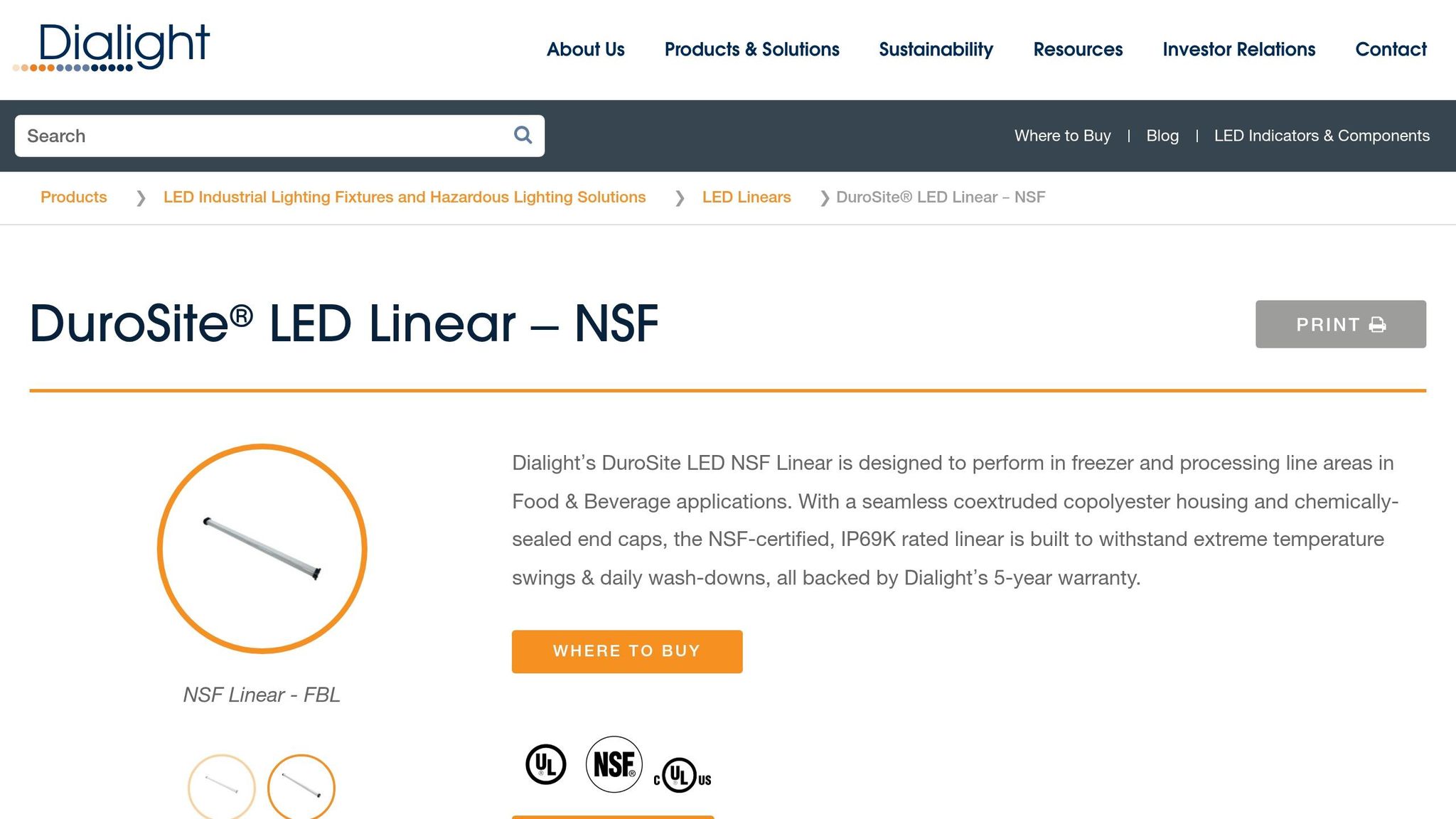
The Dialight DuroSite LED NSF Linear is a strong fit for food-processing and cold-storage areas that need a sealed linear fixture built for washdowns. It works well in spaces where sanitation rules are tighter than what a standard vapor-tight linear fixture can usually handle.
Dialight’s low-temperature design allows instant startup in subzero rooms, including deep-freeze storage.
Use IP69K in spaces with daily high-pressure washdowns. Silicone gaskets tend to keep their seal better in subzero conditions.
For food zones, choose NSF-rated construction with 316L stainless steel where chloride-based sanitizers are used often.
In racked cold-storage spaces, layout matters just as much as sealing. Use surface mounting in standard-height rooms, suspension mounting in taller ceilings, and aisle-specific optics in racked storage.
For cold rooms with constant condensation, the LightEmittingDesigns LX Series adds tighter sealing without giving up food-area use. It pairs NSF certification with NEMA 4X, NEMA 6P, and IP67 protection for damp cold rooms and food-processing areas.
Its IP67 sealing helps keep out condensation and moisture. NSF certification supports use in food-processing areas.
The ILX340/ILX450 Series is made for freezer rooms, refrigerated warehouses, and food-processing areas where sealed, low-temperature lighting is a must. It’s a strong fit when you need two things at once: cold-start performance and washdown durability.
This series is built for subfreezing conditions, so it keeps starting and operating in cold-storage settings without trouble.
Choose IP69K-rated versions in spaces where high-pressure washdowns happen on a routine basis.
NSF-rated configurations are available for food-processing and food-storage applications.
In tighter sanitation zones, this series fits best in freezer aisles, refrigerated warehouses, and washdown areas that need sealed, dependable lighting.
The SL-P69X Food-Grade Vapor Tight LED is built for food facilities that deal with frequent washdowns. It adds sealed, chemical-resistant protection in food-processing areas where water, pressure, and sanitation chemicals are part of the daily routine.
The SL-P69X operates down to -40°C (-40°F).
Its IP69K rating supports high-pressure, high-temperature washdowns up to 1,450 psi. It’s also made to handle exposure to sanitation chemicals.
NSF certification supports use in food-processing areas with strict sanitation requirements.
Use it in processing lines, wash stations, and other wet zones where sealed, chemical-resistant lighting is required. In plain terms, it’s a solid match for sanitation-heavy lines and wash stations.

For facilities that go through daily washdowns, NSF IP69K washdown linear fixtures are the step up. These sealed LED fixtures are built for food plants and cold rooms where water, cleaning cycles, and low temperatures are part of the job. They work well in meat, dairy, seafood, and beverage plants, along with cold storage rooms that get hosed down on a regular basis.
Most freezer-rated models can run in temperatures as low as -40°F (-40°C), which makes them a solid match for standard walk-in freezers and cold storage rooms. If you're lighting a blast-chill tunnel or a flash-freezing zone, check for fixtures rated down to -76°F (-60°C). Not every NSF linear fixture is built for that level of cold, so it pays to double-check the spec sheet before you buy.
An IP69K rating means the fixture can handle hot, high-pressure washdowns up to 1,450 psi at 176°F (80°C). That's a big deal in spaces where cleanup is tough and frequent.
Material choice matters too. Silicone gaskets stay flexible in subzero conditions, while standard rubber can stiffen up and lose its seal during the temperature swings that happen every time a freezer door opens.
After sealing, the next thing to check is food-safe design. NSF fixtures use smooth, non-porous, screw-free housings that are easier to clean and leave fewer spots where contamination can build up. In food inspection areas, look for a fixture with a CRI above 90.
These fixtures are best used under 26 feet (8 meters). For more even light, place them over aisles or production lines. When it comes to lens material, polycarbonate is the better pick for impact resistance, while PMMA is the better fit when chemical resistance matters more.
UFO high bays work best in large, open cold storage areas. Think refrigerated distribution centers, bulk freezer warehouses, and high-ceiling cold rooms without narrow racking. They’re a good pick when you need broad, even light across the room, not fixture layouts built around individual aisles.
In other words, these lights make the most sense in open spaces where general illumination matters more than aisle-by-aisle control. Once that’s clear, the main things to look at are the temperature rating, sealing, and beam spread.
Choose a low-temperature UFO high bay rated for continuous operation down to −40°F (−40°C). That gives you instant-on performance in large freezer spaces.
Use IP67 in rooms with heavy condensation. Go with IP69K in washdown areas. For subzero sealing, silicone gaskets are the safer choice.
For food-grade storage, use an NSF-certified housing with a smooth, screw-free enclosure.
UFO high bays are usually built for mounting heights from 20 to 50+ feet. Beam angle matters a lot here:
Skip UFO high bays in dense racking. Linear high bays do a better job in aisles, especially in spaces with narrow lanes and tall rack systems.
UFO high bays work well in open areas. Linear high bays are made for aisles. If your cold storage facility has tall racking, long warehouse lanes, or production lines, these fixtures are usually the better match.
Why? They push light downward and onto the vertical faces of racks instead of throwing it across the whole room. That helps workers see lower rack levels more clearly, which is often where the job gets done. In plain terms, they make more sense for long runs, rack faces, and production lanes.
Pick −4°F fixtures for standard coolers. Use −40°F fixtures for deep-freeze rooms.
Match the fixture to the space:
In food-grade areas, use NSF or NSF/ANSI 2 fixtures. Look for housings that are smooth, nonporous, and low-crevice.
For placement, linear high bays are usually built for mounting heights from 20 to over 50 feet. Modern units put out 160–210 lm/W, which can help cut energy use.
For dense racking, mount fixtures parallel to the aisle and use narrow or asymmetric optics.
Use this table to line up the fixture type with the room, temperature, and sanitation demands. Start with the zone first. Then check the spec sheet for temperature rating, sealing, and sanitation approvals.
| Fixture Type | Best Application Zone | Min. Temp Rating | IP Rating | NSF / Wet-Location Rating | Notes |
|---|---|---|---|---|---|
| Vapor-Tight / Tri-proof Linear | Low-bay coolers, conveyors, wash stations | −40°F (−40°C) | IP67/IP68/IP69K | NSF & Wet-Location | Good for task lighting in wet areas |
| NSF Washdown (UFO or Linear) | Food production, intensive sanitation zones | −40°F (−40°C) | IP69K | NSF Certified | Built for hot-water washdowns and sanitary areas |
| UFO High Bay | Open refrigerated warehouses, high-ceiling halls | −22°F to −40°F (−30°C to −40°C) | IP65/IP67 | Wet-Location | High output; use narrow beams at higher mounting heights |
| Linear High Bay | Freezer aisles, tall racking, packaging lanes | −22°F to −40°F (−30°C to −40°C) | IP65/IP66 | Wet-Location | Elongated output improves rack-face and label visibility in narrow aisles |
| Corrosion-Resistant Tri-proof | Areas with salt, acids, or ammonia exposure | −4°F (−20°C) | IP66 | NEMA 4X | Built for salt, acids, and ammonia exposure |
Two rules still matter here: IP69K for washdowns and NSF for food-grade housings.
In food-grade zones, stick with NSF fixtures that use smooth, nonporous, low-crevice housings. That cuts down on places where grime, moisture, or residue can hang around. Use this matrix to narrow the fixture type first, then compare models side by side.
Once you've picked the fixture types, the next step is simple: figure out whether this is a basic purchase or a job that needs outside help.
A lighting partner makes sense when a cold storage retrofit covers multiple zones, has code or signoff needs, or involves tough operating conditions.
Multi-zone facilities often need different fixture types, IP ratings, and UL classifications. That becomes even more important on mixed-temperature sites. And if the site includes classified areas, you may also need AHJ or PE signoff.
Photometric modeling also matters here. It helps verify aisle, rack, and work-surface coverage against ANSI/IES RP-7.
There’s a money side to this too. A partner can help map out controls like 0-10V or DALI dimming and occupancy sensors so the system lines up with current energy codes. DLC-listed fixtures may cut upfront costs through utility rebates, and a partner can help sort out controls, rebates, and tax paperwork, including whether the project qualifies for the 179D deduction. Lower lighting wattage in a refrigerated space can also reduce refrigeration load.
Use a lighting partner when layout, compliance, controls, or rebate work goes past a simple fixture swap. Luminate Lighting Group supports multi-zone retrofits with layout design, code review, controls planning, and rebate paperwork when a project spans multiple temperature zones or food-grade requirements.
There’s no one-size-fits-all LED fixture for cold storage. You need to match the fixture to the room’s temperature, moisture level, and sanitation needs. The options above cover the main cold-storage use cases, but the final pick comes down to one thing: fit the specs to the space. Get that wrong, and the fixture will fail sooner and cost more to replace.
Before you compare models, lock in the non-negotiables:
Miss any of those, and early failure becomes much more likely.
Use the quick check below to line up the fixture with the space.
| Environment | Recommended Protection | Key Spec |
|---|---|---|
| Blast freezer | IP66/67 | Rated to −40°F, silicone gaskets |
| Walk-in cooler | IP65/66 | Silicone gaskets |
| Food processing / washdown | IP69K | NSF certification |
| Loading dock | IP65 | IK08 or IK10 impact rating |
| High-rack aisles | IP65 | Narrow beam optics, linear form factor |
When the fixture fits the room, sanitation level, and mounting height, it tends to last longer and work better. After that, look at total project cost. A fixture that meets every site requirement is usually the smarter buy, because failure costs more.
Choose the IP rating based on how much moisture your cold storage area sees:
No matter which setting you’re working in, go with IP65 or higher. That helps reduce moisture ingress and internal frosting in freezer conditions.
Choose based on your facility layout. Linear high bays fit best in narrow aisles, rack rows, and production lines. Their long light pattern helps illuminate vertical surfaces and cut down on shadows.
UFO high bays make more sense in open freezer or warehouse areas. Their compact, round shape gives broad, even coverage.
In short: linear for long work zones, UFO for open spaces.
You need NSF-certified LED fixtures if your cold storage area is used for food processing or has to meet strict hygiene and sanitation standards. NSF certification helps show that the fixtures resist contamination, bacterial growth, and chemical corrosion. It also means they’re easier to clean and sanitize.
For standard cold storage that doesn’t involve food processing, NSF certification isn’t a strict requirement. Even so, you still need high-quality vapor-tight fixtures with at least an IP65 rating.


