.svg)
Single-source turnkey lighting cuts handoffs, controls costs, speeds installs, secures rebates, and verifies energy savings.

If you want lower project friction, one owner for the job, and a better shot at hitting energy targets, turnkey lighting usually wins.
Here’s the short version: when one provider handles the audit, design, fixtures, permits, install, controls, commissioning, rebates, and service, you deal with fewer handoffs. That often means tighter cost control, less schedule drift, and clearer responsibility if something goes wrong. By contrast, the old multi-vendor setup puts more work on your team and makes it easier for scope gaps, delays, and warranty disputes to show up.
In this article, I compare both approaches across the points most buyers care about:
A few numbers stand out right away:
If I had to sum it up in one line, it’s this: turnkey lighting trades some direct owner control for less admin work, fewer gaps, and more predictable outcomes.
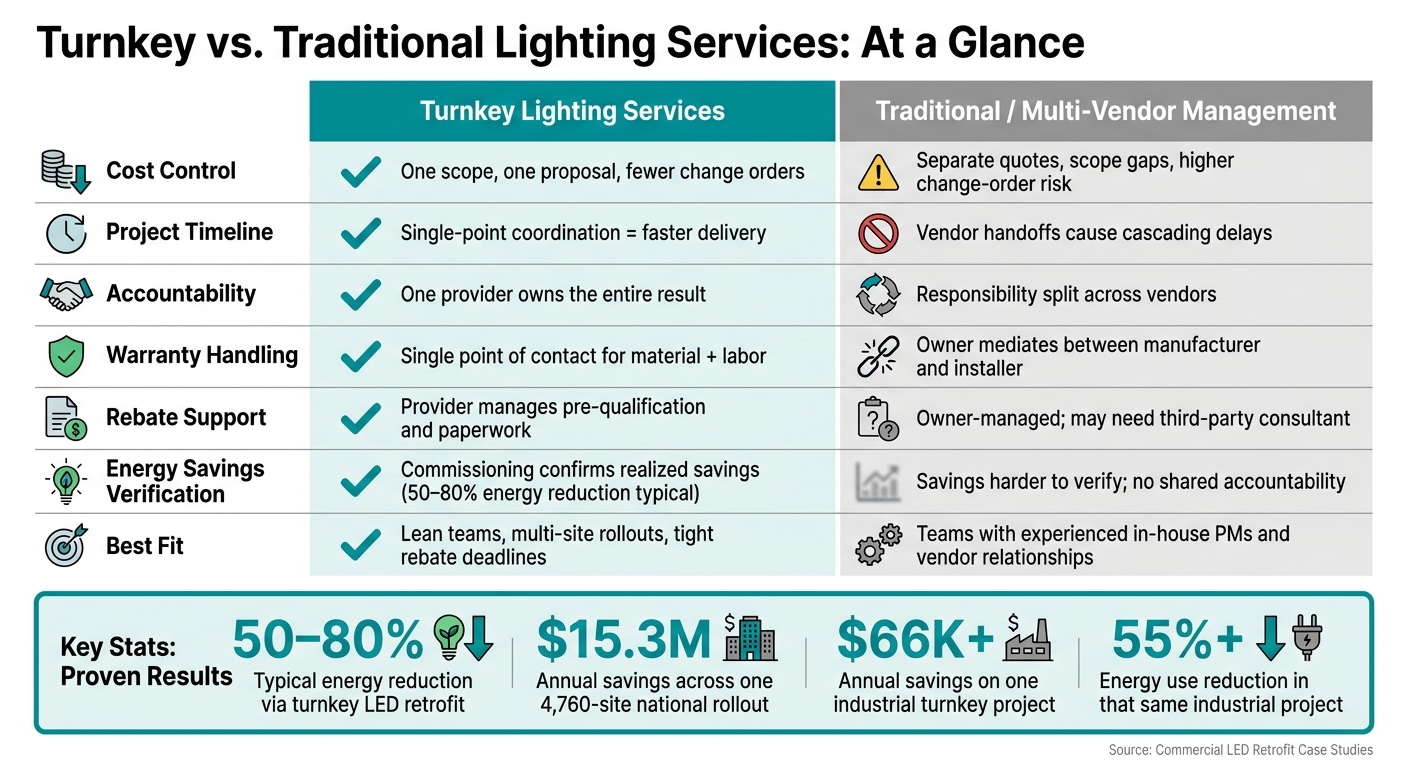
Turnkey vs. Traditional Lighting: Side-by-Side Comparison
| Criteria | Turnkey Lighting Services | Multi-Vendor Project Management |
|---|---|---|
| Cost control | One scope, fewer gaps, less owner admin | More handoffs, more change-order risk |
| Timeline | One team handles sequencing and install | Delays can stack across vendors |
| Accountability | One provider owns the result | Responsibility is split |
| Warranty handling | Single point of contact | Owner may need to sort out disputes |
| Rebates | Provider often handles paperwork | Owner usually handles it |
| Energy verification | Commissioning and savings review are often included | Savings proof may be harder to pin down |
| Best fit | Lean teams, multi-site jobs, rebate deadlines | Teams with in-house PM staff and vendor ties |
So if you’re choosing between one-source delivery and a split-vendor model, this comparison shows where each one helps - and where it can create extra work for you.
Turnkey lighting services wrap the whole job into one package: audit, design, permitting, installation, commissioning, rebate support, and post-installation service. Instead of passing work from one company to the next, you deal with one provider from start to finish. That cuts handoff mistakes, trims delays, and puts cost, speed, and accountability into a single workflow.
A single-source setup cuts coordination time and admin work. There’s less back-and-forth, fewer moving parts, and less room for things to get lost in the shuffle.
Some turnkey providers are also vendor-neutral, which means they choose fixtures based on performance and long-term ROI, not because they need to push certain inventory. They also take care of rebate pre-qualification and submission, which lowers the client’s admin load and can shorten payback periods.
That same tighter coordination also helps the project move faster.
When design, permitting, and installation are handled under one roof, the workflow tends to move with less drag. Licensed crews can be scheduled in a way that limits downtime and avoids unnecessary disruption to day-to-day business operations.
The scale can be huge. In one nationwide rollout, a single project team managed 4,760 locations and delivered $15.3 million in annual savings.
One contract means one point of accountability. If there’s a warranty issue, a code question, or a post-installation service need, the turnkey provider owns it. There’s no finger-pointing and no gray area about who has to fix the problem.
That matters most when warranty terms, code compliance, and system performance are all tied to the same project.
Commercial LED retrofits delivered through a turnkey model often cut energy use by 50% to 80%. In one industrial project, the upgrade cut energy use by more than 55% and saved over $66,000 per year without interrupting operations.
After installation, providers verify savings through testing and ROI documentation. That’s the point where a lighting upgrade stops being just a facility project and starts showing up as measurable operating savings.
These strengths stand out even more when you compare them with the split responsibilities in old-school project management.
In a traditional setup, the facility owner often ends up acting like the project manager. They hire and manage separate vendors for the audit, design, product procurement, and electrical installation. Each one brings its own contract, schedule, and priorities. That means the owner or facility team has to hold the whole job together, even though no single vendor is responsible for the final result. And that split shows up in cost, timing, accountability, and performance.
When coordination is split across multiple parties, costs tend to creep up. If the lighting designer, product distributor, and electrical contractor aren't working from the same plan, scope gaps often turn into change orders. The owner also ends up handling rebate paperwork and warranty coordination, which adds more admin work and more room for mistakes.
Managing multiple contractors isn't easy. One delay can trigger another, and then another. If one vendor falls behind, the rest of the schedule can slide with it. Without one team running the timeline from end to end, installations are more likely to spill into business hours and interrupt day-to-day operations.
This is usually the weakest part of the old model. When responsibilities are divided, it's easier for missed compliance items, weak documentation, and unresolved defects to slip through the cracks. In lighting projects, that can lead to missed code compliance, unverified savings, or rebate errors.
Energy savings depend on the right fixture selection and accurate modeling, and both become harder to manage when different parties handle different parts of the job. In a traditional model, those steps sit with separate vendors, but no one shares responsibility for the final outcome. As a result, savings are harder to verify, not just harder to deliver.
The earlier sections looked at each model on its own. Here, the comparison gets more practical: cost control, schedule, accountability, and actual savings after the job is done.
With a turnkey provider, the owner gets one proposal that covers design, materials, labor, permitting, and rebate coordination. That matters because a single pre-bid scope helps cut down change-order risk.
In a more traditional setup, design, fixtures, and labor are usually scoped by different parties. And that’s where things can get messy. When those scopes don’t line up, the gaps often turn into extra costs that land on the owner’s desk.
There’s also a product-selection difference. In a turnkey model, fixtures are chosen based on performance and ROI, not because someone needs to move inventory.
A turnkey model puts procurement, scheduling, and field execution under one team. That single-point coordination makes it easier to plan work around business hours and keep downtime low.
In a traditional setup, the owner often has to manage the handoffs between vendors. If one contractor falls behind, that delay can spill into the rest of the schedule. It’s a bit like a missed flight connection: one problem early on can throw off the whole trip.
Turnkey gives the owner one point of contact for labor, materials, permitting, and code-related issues. If something goes wrong, one provider handles both the material side and the labor side.
That’s a big shift from the traditional model, where those duties are often split between the manufacturer and installer. When that happens, disputes over who owns the problem can slow down the fix.
Permitting and code compliance are also handled in-house with a turnkey provider, which helps reduce the chance of missed inspections or compliance gaps.
This is where the long game starts to show. Commissioning helps close the gap between modeled savings and actual savings. Turnkey providers commission control systems - sensors, dimmers, and occupancy controls - after installation to confirm they’re working as designed.
They also handle utility rebate paperwork from pre-qualification through submission and support Section 179D documentation. In a traditional model, that work usually falls to the owner or requires bringing in a third-party consultant.
Here’s the side-by-side breakdown:
| Criteria | Turnkey Lighting Services | Traditional Project Management |
|---|---|---|
| Budget Certainty | High; single pre-bid scope reduces change-order risk | Variable; separate quotes require close owner oversight |
| Installation Timeline | Faster; single-point coordination for procurement and labor | Slower; vendor handoffs can cause cascading delays |
| Warranty Handling | One provider owns material and labor issues | Split between manufacturer and installer; owner often mediates |
| Site Disruption | Minimized; work sequenced around active operations | Higher risk; less coordination between design and field execution |
| Rebate Capture | Managed by provider, including pre-qualification and paperwork | Owner-managed; may require a third-party consultant |
| Long-Term Savings | Commissioning verifies realized savings; rebate and 179D support included | Variable; initial bid price often takes priority over realized savings |
The next question is simple: which model matches your team's bandwidth and the job's complexity?
At its core, this choice is about control vs. convenience. A turnkey setup takes more off your team's plate. A standard project management setup keeps more of the work in-house.
The main trade-off is internal control versus outsourced coordination.
| Turnkey Lighting Services | Traditional Project Management | |
|---|---|---|
| Upfront cost | Higher service fees, lower internal labor | Lower fees, higher internal workload |
| Vendor flexibility | Provider selects fixtures based on performance and ROI | Owner can tap existing supplier relationships |
From there, the best fit depends on how much coordination your team can realistically take on.
Turnkey works well for lean teams, multi-site rollouts, and jobs with tight rebate deadlines. Fewer handoffs usually mean tighter scheduling and less back-and-forth.
With one provider handling the audit, design, installation, permitting, and rebate submission, the internal coordination load drops a lot. That can make a big difference when your team is already stretched thin.
The standard model works best for organizations with seasoned in-house project managers, long-term vendor relationships, or procurement rules that require direct vendor control.
That said, split responsibilities can create mix-ups, clashing schedules, and scope creep. If no one on your side has enough time to keep all the moving parts lined up, the coordination burden can grow fast.
The choice comes down to one thing: which model gives you more predictable cost, timing, and accountability.
For most U.S. commercial lighting projects, turnkey services have the edge. They tend to move faster, make coordination simpler, and help teams stay on top of rebate capture. With turnkey services, there are fewer handoffs and one main point of accountability.
Traditional project management can work. But it usually works best when your team already has the staff and hands-on experience to manage several vendors without things slipping through the cracks.
Bottom line:
That’s the core value of turnkey lighting services: fewer handoffs, clearer accountability, and more predictable results.
Turnkey lighting services cut project risk because they give you one clear point of accountability. Instead of juggling several vendors and chasing updates across teams, you work with a single partner that handles the full job.
That also makes communication much simpler. When one team manages everything from planning through installation, projects are more likely to stay on time, stay on budget, and cause fewer disruptions along the way.
Yes. For a single-site project, turnkey lighting can be worth it because it gives you one streamlined, cost-effective setup from start to finish.
It can also help limit disruptions, support safety and code compliance, and improve both energy savings and lighting quality.
Ask about their process for site assessment, project management, and compliance. Make sure they do a full on-site lighting audit so they can spot waste, find weak points, and put together a plan that fits your space.
You’ll also want to ask how they handle the whole job from start to finish, including:
It also helps to confirm they’ve worked with your type of facility before. On top of that, check their safety protocols and ask how they deal with utility incentives and warranty support.


