.svg)
Predictive maintenance with IoT sensors reduces LED downtime and maintenance costs, improves energy efficiency, and extends fixture life in large facilities.

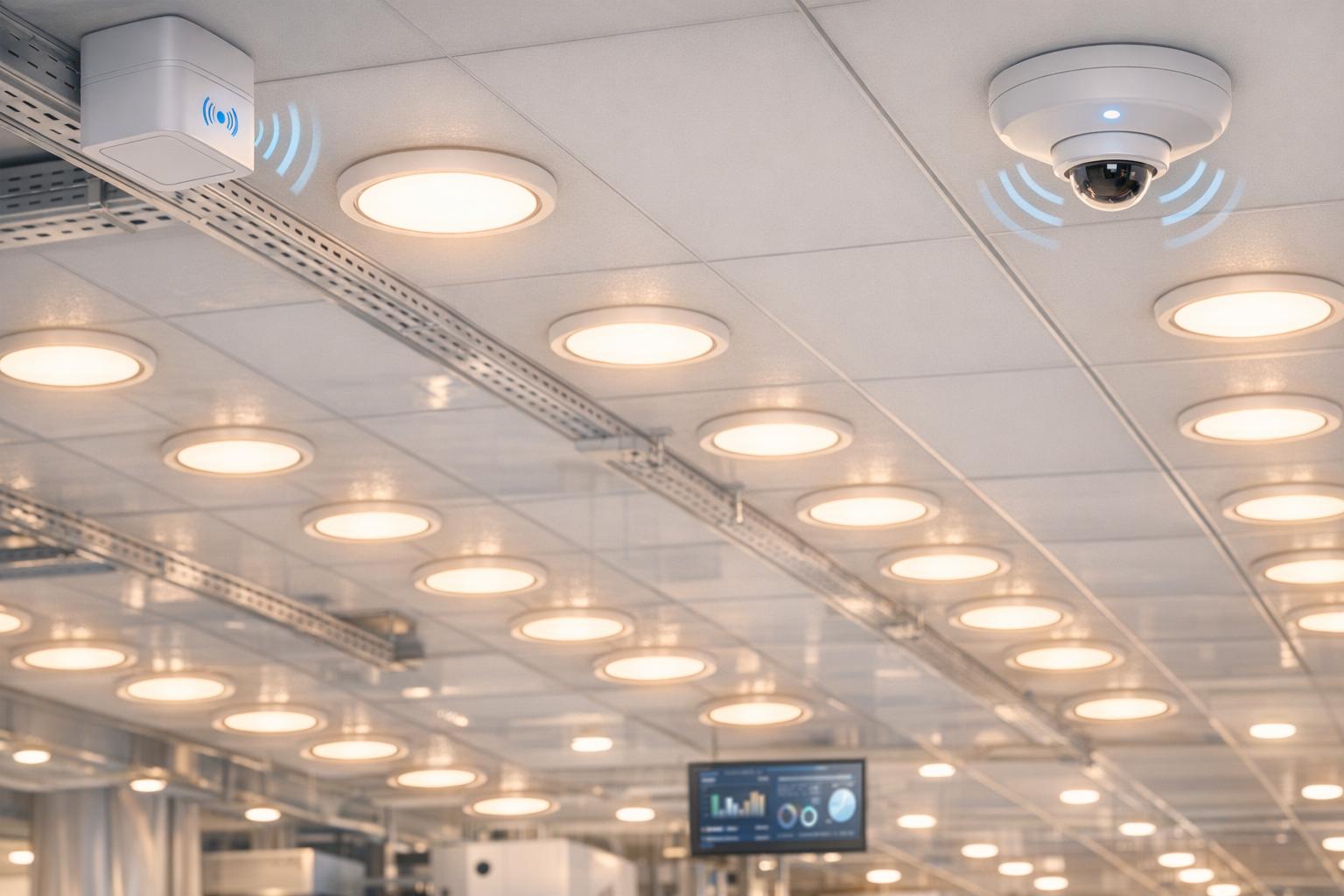
LED predictive maintenance saves money, extends lifespan, and improves reliability. By using real-time data and IoT sensors, it identifies issues like overheating or lumen degradation before failures occur. This minimizes downtime, reduces maintenance costs by up to 30%, and extends LED lifespan by 20–40%. It’s especially valuable for commercial spaces, warehouses, and municipalities where consistent lighting is critical.
Predictive maintenance turns LED lighting into a reliable, cost-effective asset while reducing operational disruptions and energy waste.
LED fixtures are designed to last between 50,000 and 100,000+ hours - that’s roughly 10 to 20 years of use. However, factors like environmental stress, voltage fluctuations, and heat can cause premature failures, cutting their lifespan short and impacting return on investment (ROI).
Predictive maintenance offers a solution by keeping tabs on LED health in real time. With IoT sensors, it’s possible to monitor critical signals like board temperature, phase current, and voltage fluctuations - hidden factors that can damage components like drivers and electrolytic capacitors. When early signs of wear or degradation appear, the system sends alerts, allowing for quick action before a small issue snowballs into a major failure. This proactive approach ensures technicians step in only when necessary, avoiding unnecessary maintenance or part replacements.
"Each significant failure can shorten the lifespan of the asset - and ROA." - Doug Ansuini, VP, Senior Software Architect, LLumin
By addressing issues before they escalate, facilities can achieve up to 20% more equipment uptime and reduce breakdowns by as much as 70%. For industries that operate 24/7 - like warehouses or municipal street lighting - this reliability means safer environments and fewer costly emergency repairs.
Another advantage of continuous monitoring is tracking lumen maintenance, which refers to the gradual dimming of light output over time. By identifying fixtures that are nearing critical thresholds (e.g., 70% of their original brightness), facilities can plan replacements during scheduled downtime instead of dealing with unexpected outages.
Predictive maintenance offers a smarter way to cut costs by moving away from the traditional "fix it when it breaks" mindset. Instead, it relies on data to guide timely interventions. Research from the U.S. Department of Energy shows that facilities using predictive methods enjoy 25–30% lower maintenance costs and 35–45% less downtime. Industry analysis further backs this up, reporting 10–40% reductions in maintenance expenses and up to 50% fewer unplanned downtime events. These numbers highlight the financial advantages of using data-driven strategies.
When comparing maintenance methods, the cost difference becomes clear. Reactive repairs and fixed-schedule maintenance often lead to higher expenses and more downtime. Predictive maintenance, on the other hand, uses IoT sensors to monitor real-time conditions - like temperature changes or lumen degradation - and acts only when needed.
One compelling example comes from an educational institution that saved $15,000 annually after adopting an LED lighting maintenance plan. This approach not only reduced costs but also improved the reliability and quality of classroom lighting. For commercial facilities, the benefits go beyond repair savings - less downtime means fewer productivity losses, which is especially critical for 24/7 operations where lighting failures can disrupt workflows and cost thousands per hour.
Predictive systems also make resource management more efficient. Repairs are scheduled based on real-time equipment data, allowing facilities to align maintenance with planned downtime. This avoids disruptions during peak hours and eliminates costly emergency callouts. For LED street lighting, predictive algorithms estimate the remaining useful life (RUL) of components and work with remote dimming controls to extend service intervals and reduce the need for frequent replacements.
"Upgrading to energy-efficient LED lighting is one of the fastest ways to lower operating costs." - Luminate Lighting Group
Predictive maintenance plays a key role in keeping LED systems efficient by catching early signs of lumen degradation - like when a fixture dips below 70–80% of its original brightness. IoT sensors monitor factors such as temperature, luminous flux, and electrical current for each fixture. This data allows the system to either dim lights or flag them for repair before energy waste spirals out of control. By focusing on actual conditions, this approach ensures that lights provide the right level of illumination without consuming excess power to make up for unnoticed declines. These real-time insights also pave the way for advanced analytics that further optimize performance.
Using real-time data and algorithms, systems can predict the remaining useful life (RUL) of fixtures and identify operational issues that might lead to inefficiency. For example, in LED street lighting equipped with telemanagement systems, predictive models have extended the service life of fixtures beyond what manufacturers estimated. Automated dimming, triggered by signs of degradation, has also helped reduce electricity costs. Studies in industrial settings reveal that analytics-driven maintenance programs can lower maintenance expenses by 20–30% and cut unplanned downtime by 30–50%, directly supporting energy efficiency by preventing power waste from malfunctioning equipment. These insights demonstrate how integrated smart systems can further enhance energy savings.
When predictive maintenance is paired with smart controls - like occupancy sensors or daylight harvesting systems - it amplifies energy efficiency even more. Just as predictive methods extend LED lifespans and reduce maintenance costs, they also help maintain peak energy performance. For U.S. commercial buildings, this combination preserves the 50–70% energy savings typically achieved through LED retrofits. These savings not only lower utility bills but also improve eligibility for performance-based incentives.
"Many of our clients see energy reductions of 50–80%, along with improved light quality, reduced maintenance, and better workplace safety." - Luminate Lighting Group
Keeping systems running smoothly also reduces the need for emergency repairs and service calls, freeing up funds for high-efficiency upgrades and advanced controls that further minimize energy use. In settings like warehouses, industrial facilities, and office buildings, combining LED retrofits with predictive maintenance and re-commissioned controls ensures long-term energy savings. This approach also supports 179D tax deductions and qualifications for utility rebates, making it a win-win for energy-conscious businesses.
Predictive maintenance transforms LED lighting into an active safety tool by identifying critical signals that could indicate hazards like overheating drivers, arcing connections, or intermittent failures - well before they escalate into bigger problems. Facilities can configure alerts for when fixtures exceed safe operating thresholds or when light levels fall below required standards in areas such as warehouses, loading docks, or stairwells. This allows maintenance to be scheduled during planned downtimes instead of scrambling for emergency repairs. These preventive actions not only reduce the risk of safety incidents but also help ensure compliance with regulatory standards.
Predictive systems play a key role in keeping emergency and task lighting compliant with OSHA, NFPA, IES, and the National Electrical Code. By forecasting when LEDs might fail to meet maintenance targets, teams can proactively adjust or replace fixtures to stay ahead of potential issues. Automated analytics replace the need for manual inspections by continuously monitoring emergency lighting performance, verifying that exit signs and egress paths are fully functional during power outages.
This proactive approach can cut unplanned downtime by about 35–45% and enhances audit readiness with detailed condition data and documented corrective actions. Together, these measures strengthen both safety and operational efficiency.
"Our licensed electricians ensure full code compliance and minimal disruption to your operations."
- Luminate Lighting Group
Luminate Lighting Group integrates these predictive safety features into their LED retrofit solutions. They specify fixtures with built-in diagnostics and configure systems for continuous condition monitoring. This strategy not only improves safety and risk management but also aligns with energy audits, utility rebate programs, and 179D tax deduction opportunities. By combining energy savings with tax incentives, these upgrades deliver both immediate and long-term benefits.
Predictive maintenance transforms LED lighting from a routine expense into a strategic tool. Smart sensors collect detailed data - such as lumen output, power usage, temperature, and operating hours - and feed it into advanced prognostics and health management (PHM) models. These models estimate the remaining useful life (RUL) of each light fixture based on its actual wear and tear rather than relying on generalized manufacturer ratings. With this information, managers can pinpoint fixtures nearing the end of their lifespan and plan replacements over multiple years, reducing the risk of unexpected failures. This real-time data paves the way for smarter, more efficient capital planning.
The financial advantages of this approach are clear. By relying on real-world health data instead of arbitrary age-based replacement schedules, organizations can extend the life of their assets, delay large-scale replacements, and allocate funds to projects with higher value. For instance, instead of setting blanket budgets to "replace all fixtures at year X", asset managers can use RUL data to create detailed 3–10 year replacement plans. These plans show exactly how many fixtures will need replacing and when, allowing for better alignment with budget cycles.
This data also enables smarter portfolio management. By analyzing site-wide trends, organizations can determine which products degrade the fastest and standardize future purchases on more reliable options. Combining asset health scores with energy data helps rank sites based on their potential benefits from retrofits. Many telemanagement platforms now offer APIs or exports that integrate asset condition and RUL data directly into computerized maintenance management systems (CMMS) and enterprise asset management (EAM) tools. This allows maintenance tasks to be triggered by actual health metrics rather than fixed schedules.
"Through meticulous analysis, we develop detailed models to showcase the projected efficiency improvements, helping clients make informed decisions towards sustainable lighting solutions."
- Luminate Lighting Group
Luminate Lighting Group takes these insights further by using predictive data and energy audits to create comprehensive asset and capital plans for commercial and municipal facilities. By mapping out predicted failure dates, current energy performance, and compliance with code requirements, they can recommend priority areas for retrofits, calculate annual savings in kilowatt-hours and U.S. dollars, and identify opportunities for utility rebates and 179D tax deductions to help offset costs. This data-driven strategy integrates maintenance, energy savings, and capital spending into a single, actionable plan, improving budgeting accuracy while maximizing return on investment.
Predictive maintenance takes LED lighting to the next level by embedding it into your building's digital ecosystem. With IoT-connected sensors built directly into LED fixtures, these systems continuously stream real-time data - covering metrics like temperature, power usage, lumen output, and operating hours - straight into your building management system (BMS) or a cloud platform. This two-way communication allows the lighting system to work seamlessly with HVAC, security, and occupancy systems, offering a unified view of your building's performance. The result? A more coordinated and efficient approach to managing your space.
Through networked controls, gateways, and analytics platforms, fixture data is monitored and integrated into your system. Open protocols ensure compatibility with existing infrastructure, making integration smooth. For example, if analytics detect a drop in lumen output in a specific area - possibly due to higher ambient temperatures - the system can send a predictive alert, create a maintenance ticket, and even instruct the BMS to adjust HVAC airflow. This coordinated response not only prevents unexpected outages but also ensures compliance with OSHA lighting standards and streamlines labor scheduling.
The benefits extend far beyond lighting. By analyzing fixture temperature spikes alongside HVAC performance, facility teams can identify ventilation issues before they escalate. Combining temperature data with occupancy patterns allows for more precise maintenance schedules. Plus, linking lighting health alerts to safety systems ensures critical areas like emergency exits and exterior security lights remain operational. This approach reduces service calls, sharpens diagnostics, and aids in smarter long-term planning.
Interoperability and cybersecurity are key to making this work. Choosing controls and gateways that support widely recognized protocols and APIs ensures smooth integration with existing systems. To enhance security, lighting traffic can be routed through dedicated VLANs, with role-based access controls and regular firmware updates in place. This segmentation allows maintenance teams to access the data they need without compromising core business systems. In turn, this integration boosts reliability and cost efficiency, reinforcing the value of predictive maintenance.
Luminate Lighting Group specializes in designing networked LED systems equipped with embedded sensors and controls that align with existing BMS and IT standards. Their dashboards and workflows are tailored for proactive maintenance across warehouses, industrial sites, offices, and municipal buildings. Projects are structured to qualify for U.S. utility rebates and 179D tax deductions, leveraging documented energy savings and advanced control capabilities. This approach not only reduces integration risks but also accelerates ROI for building owners adopting smart lighting strategies. It’s a practical complement to earlier discussions on cutting costs and extending asset lifespans.
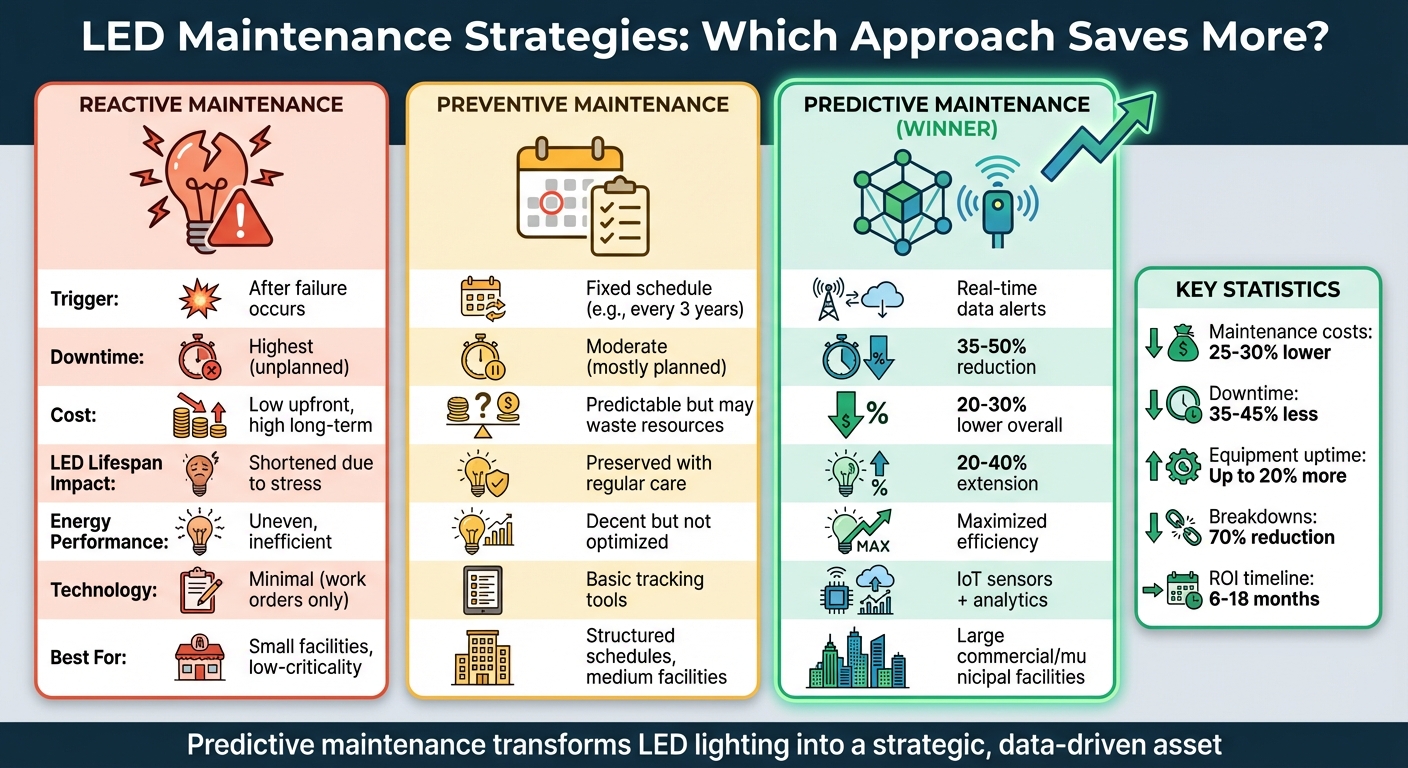
Reactive vs Preventive vs Predictive LED Maintenance Comparison
The table below highlights how reactive, preventive, and predictive maintenance strategies stack up for LED lighting systems equipped with smart controls and IoT connectivity.
| Criteria | Reactive Maintenance | Preventive Maintenance | Predictive Maintenance |
|---|---|---|---|
| Primary Trigger | Responds only after a failure is visible or reported by occupants. | Scheduled based on fixed intervals or operating hours (e.g., every 3 years). | Uses real-time data like changes in lumen output, temperature spikes, driver faults, or unusual power usage to detect potential issues. |
| Typical Downtime | Highest unplanned downtime, often during peak usage hours. | Moderate downtime; most work is planned, but unexpected failures can still happen between checks. | Minimizes downtime by 35–50%, with maintenance typically scheduled during off-hours. |
| Maintenance Cost Profile | Low upfront costs but higher long-term expenses due to emergency repairs and productivity losses. | Predictable costs, though replacing parts prematurely can lead to inefficiencies. | Higher initial investment in sensors and analytics, but overall costs can drop by 20–30%, with unplanned downtime reduced by 30–40%. |
| Impact on LED Lifespan | Running components to failure adds stress, shortening the lifespan of LEDs and drivers. | Regular cleaning and inspections help preserve lifespan but may miss signs of accelerated wear. | Early detection and timely fixes can extend fixture lifespan by 20–40%. |
| Energy Performance | Results in uneven lighting and missed energy-saving opportunities due to degraded or misaligned fixtures. | Maintains decent performance, though not always optimized between service intervals. | Maximizes energy efficiency by quickly identifying underperforming fixtures, failed sensors, or control issues, ensuring consistent lighting. |
| Data & Technology Requirements | Relies on minimal technology, such as work orders from complaints or routine patrols. | Uses basic tools like run-hour tracking and simple scheduling, with limited reliance on smart systems. | Leverages advanced IoT sensors, networked controls, and analytics for condition-based maintenance. |
| Fit with Smart LED Systems & IoT | Does not fully utilize diagnostic data from connected lighting systems, making it a poor match for smart environments. | Provides decent reliability but doesn’t take full advantage of modern smart system capabilities. | Fully aligns with networked LEDs, occupancy or daylight sensors, and cloud-based analytics for proactive maintenance. |
| Best-Fit Use Cases | Suitable for small facilities with low-criticality lighting needs and minimal smart controls. | Ideal for environments that follow structured maintenance schedules but don’t require advanced analytics. | Perfect for large-scale commercial or municipal settings - like warehouses, industrial plants, offices, and streetlighting - where connected LED systems deliver maximum value through predictive care. |
This comparison underscores why predictive maintenance is the go-to strategy for modern smart lighting systems.
For U.S. building owners, the advantages of predictive maintenance - paired with energy-efficient LED retrofits and networked controls - are clear. Companies like Luminate Lighting Group design systems that generate detailed data for predictive analytics, helping clients cut emergency service calls, extend the life of fixtures, and achieve financial savings. This data-driven approach turns lighting into a proactive asset, supporting both long-term planning and operational efficiency.
Predictive maintenance takes LED lighting beyond just being an operational cost - it turns it into a strategic tool that delivers measurable value. By catching issues early, it helps LEDs reach their full 10–15 year lifespan, cuts unplanned downtime by as much as 40%, and trims maintenance expenses by 25%. This shift from reactive problem-solving to precision-driven planning leads to fewer emergency repairs, lower spare-part costs, and consistently reliable lighting performance.
The financial and operational benefits of predictive maintenance are clear. Programs like these often pay for themselves within 6–18 months, while offering long-term perks like improved energy efficiency, enhanced safety compliance, and better capital planning. When combined with networked controls and IoT sensors, LED systems can deliver detailed data to fine-tune individual fixtures, schedule maintenance during non-peak hours, and align with sustainability initiatives.
For U.S. facility managers managing warehouses, offices, industrial plants, or municipal spaces, the next steps are straightforward: identify key lighting areas, establish performance benchmarks, and integrate condition-monitoring data into daily operations. Luminate Lighting Group specializes in LED systems designed for predictive analytics from the start, offering smart controls, energy audits, and ongoing support to ensure your lighting investment delivers maximum value over its 10–15 year lifespan.
Predictive maintenance leverages advanced sensors and analytics to keep a close eye on LED fixtures in real time. It can detect potential issues such as overheating, voltage irregularities, or component wear before they escalate into serious problems. By tackling these concerns early, it helps avoid unnecessary stress on the LEDs, allowing them to function smoothly for a longer time.
This forward-thinking method not only prolongs the lifespan of your LED lighting but also minimizes the need for frequent replacements. The result? You save both time and money while ensuring your lighting continues to perform reliably.
Predictive maintenance for LED lighting systems offers a way to save money over time, though the upfront investment can vary based on a few key factors. These include how large your facility is, how intricate the system setup is, and what kind of technology or sensors are needed.
While the exact price tag will differ from one business to another, many companies discover that the benefits - like energy savings, longer LED lifespans, and lower maintenance costs - can quickly make up for the initial expense. To get a clearer picture of what your investment might look like and the returns you can expect, it’s a good idea to consult with a professional lighting solutions provider.
Predictive maintenance leverages advanced sensors and AI to keep a close eye on how LED lighting systems are performing in real time. By catching early warning signs - like dips in performance or indicators of potential failure - it ensures the lighting stays efficient and reliable.
This forward-thinking method doesn’t just prevent problems; it also cuts down on energy waste. In fact, it can slash electricity use by an impressive 30–40%. Plus, it keeps lighting quality consistent, creating a well-lit space while supporting energy savings.


