.svg)
Building hours, lighting load cuts and PWA compliance—not industry label—determine 179D deduction value.

If you want the short answer, here it is: manufacturing often leads on 179D value per square foot, municipal projects can produce large deductions through allocation, and office buildings usually land in the middle.
I’d judge these projects on four things first: deduction per sq. ft., total deduction size, building hours, and documentation needs. A plant running 24/7 can outpace an office with the same lighting upgrade, while a government building can still create strong tax value by assigning the deduction to the designer.
Here’s the article in plain terms:
179D Tax Deductions by Industry: Manufacturing vs. Municipal vs. Office
| Building type | Deduction trend | Main driver | Common runtime | Main tax setup |
|---|---|---|---|---|
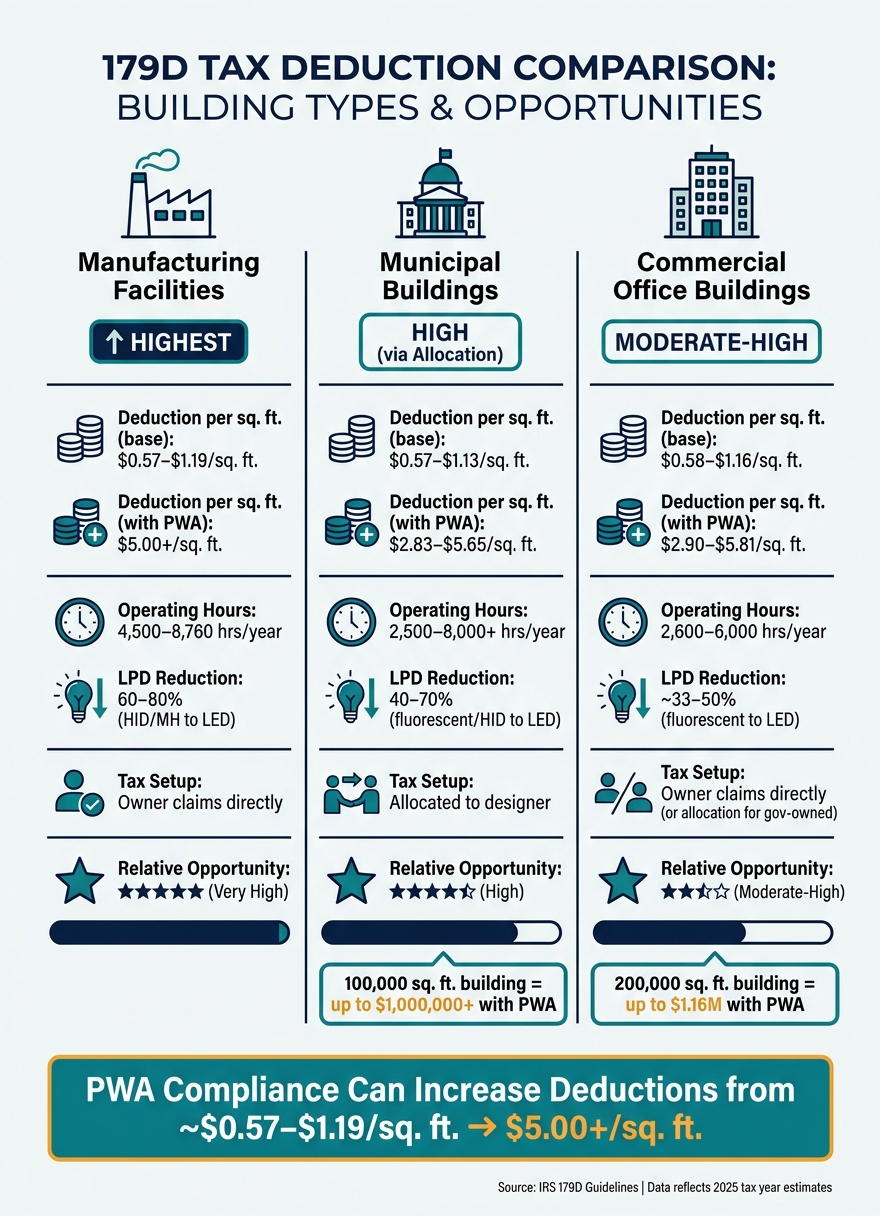
| Manufacturing | Highest in many cases | Large LPD cuts + long hours | 4,500-8,760 hrs/year | Owner claims directly |
| Municipal | High, especially with PWA | Allocation + public building hours | 2,500-8,000+ hrs/year | Deduction allocated to designer |
| Office | Mid-range | LPD cuts + controls | 2,600-6,000 hrs/year | Owner claims directly, or allocation for government-owned offices |
My takeaway: you should not rank 179D projects by industry name alone. You should rank them by hours, load reduction, square footage, tax position, and paperwork readiness. That gives you a much better read on where the tax savings will be strongest.
Below, I break down how each building type stacks up and where the numbers tend to move the most.
In side-by-side industry comparisons, manufacturing usually sits at the top end of 179D value. The reason is pretty simple: these buildings pair big square footage with long operating hours. A plant running two or three shifts uses lighting far longer than a standard office, so every watt saved adds up faster over the course of a year. That’s why manufacturing often leads in both deduction intensity and total deduction value, not only raw project size.
That scale matters because 179D is claimed on a per-square-foot basis. When a plant has a large footprint and long runtime, the total deduction can climb fast. Pre-2023 projects were capped near $1.80 to $1.88 per sq. ft. There was also an interim lighting-only partial deduction of $0.30 to $0.63 per sq. ft. when lighting power density dropped by 25% to 40%.
A lot of manufacturing sites still rely on older metal halide (MH) or high-pressure sodium (HPS) fixtures. Those systems tend to carry high lighting power density, which leaves plenty of room for savings. Swapping them for LED high-bays often cuts LPD by 60% to 80%, which can help a project clear 179D energy-savings thresholds. In practice, modern LED retrofits in industrial spaces often get past those marks.
Operating hours play a big role in the 179D energy model. A two-shift operation will often log 4,500 to 5,000 hours per year, while a three-shift or 24/7 facility can hit 8,200 to 8,760 hours. That kind of runtime makes kWh savings hit harder. Add controls like occupancy sensors, daylight harvesting, and scheduled shutoffs, and the modeled savings can climb without adding more fixtures. Those modeled results feed straight into the project’s tax value and payback.
For privately owned plants, the building owner claims the deduction directly. On the cost side, LED fixtures rated for 50,000 to 100,000 hours can trim both energy use and maintenance spend. Utility rebates can also pull payback down to 1.4 to 2 years in heavy industrial retrofits. Put it all together, and manufacturing becomes the yardstick for high-value 179D lighting projects.
Municipal buildings can't take the 179D deduction themselves because they're tax-exempt. Instead, they pass it to the designer, architect, engineer, or energy services firm through a formal allocation letter.
That changes the game a bit. In manufacturing, runtime and load cuts often do the heavy lifting. In municipal work, ownership structure, labor rules, and clean documentation tend to matter more. So while factories often stand out because they run long hours, municipal projects often stand out because they can meet labor-bonus rules and keep the paperwork tight.
The dollars per square foot can be strong here. Under current IRS rules, qualifying municipal projects typically qualify for $0.57–$1.13 per sq. ft. at the base rate, or $2.83–$5.65 per sq. ft. when prevailing wage and apprenticeship rules are met.
That adds up fast:
A lot of older municipal buildings - courthouses, administrative offices, and police stations - were built with LPDs in the range of 1.0–1.5 W/sq. ft., often using fluorescent, HID, or incandescent fixtures. A targeted LED retrofit can bring that down to 0.35–0.60 W/sq. ft., which works out to a 40–70% reduction.
That drop doesn't just look good on paper. It feeds straight into the energy model used to support 179D qualification.
Municipal buildings don't all run on the same schedule, and that has a big effect on 179D value. A standard city hall or administrative office might log 2,500–3,500 hours per year, while a police station or emergency operations center running 24/7 can reach 8,000+ hours annually.
Here's where the math gets more interesting: a 30,000 sq. ft. police station that cuts lighting demand by 15 kW at 8,000 hours per year saves roughly 120,000 kWh annually. That's about double the savings of a similar-sized office building running half as long.
More annual energy savings can make it easier for a project to clear the efficiency thresholds tied to top per-square-foot deductions. That's why 24/7 public safety facilities often stand out as strong 179D candidates.
Utility rebates can bring simple payback down to 3–7 years, depending on local electricity rates and project size. And there's a practical step that helps more than people expect: writing 179D requirements into RFPs and contracts. Doing that early can tighten documentation and make it easier to lock in a stronger energy-saving scope.
Office buildings usually land somewhere in the middle: less runtime than manufacturing, but more steady occupancy than many municipal facilities.
Office buildings usually fall somewhere between plants and public buildings. They don't run as long as manufacturing sites, but they tend to have more steady occupancy than municipal space. That makes them a solid fit for 179D, especially when a lighting upgrade includes smart controls and meets prevailing wage and apprenticeship (PWA) rules. In office projects, savings usually come from a mix of lower lighting power density and tighter scheduling, not just long runtime.
For 2025, office projects that reach at least 25% whole-building energy savings compared with the applicable ASHRAE baseline can qualify for $0.58-$1.16 per sq. ft. before PWA, or $2.90-$5.81 per sq. ft. with PWA.
On a 200,000 sq. ft. office building, that means:
The final amount depends on how much the retrofit cuts lighting load.
Many older office buildings still use older fluorescent or HID systems and sit around 0.9-1.2 W/sq. ft. A well-planned LED retrofit, paired with task and ambient lighting, can often bring that down to 0.61-0.74 W/sq. ft.
That drop feeds straight into modeled energy savings, which can increase 179D value.
A standard office that runs 10 hours a day on weekdays usually lands at about 2,600-3,000 hours per year. For a 50,000 sq. ft. office, cutting LPD from 1.0 to 0.6 W/sq. ft. at 3,000 hours per year saves about 60,000 kWh annually.
If the building has extended-hour areas, the math changes fast. Co-working spaces, call centers, and sites with overnight operations can hit 6,000 hours per year, which pushes savings from that same LPD cut closer to 120,000 kWh.
Occupancy sensors can add even more. Conference rooms and private offices often sit empty for chunks of the day, so controls can trim waste that fixture swaps alone won't catch. In many office jobs, schedule-based controls matter just as much as the fixtures themselves.
Privately owned office buildings usually claim 179D directly. Government-owned office projects can allocate the deduction to the designer. And for mixed-use portfolios, project-level tracking matters if you want to avoid double-counting.
The ROI picture is often pretty straightforward. A 200,000 sq. ft. office retrofit with a $1,000,000 cost might save $150,000 per year in energy and maintenance, qualify for a $400,000 179D deduction, and bring in $100,000 in utility rebates. At a 25% effective tax rate, that deduction produces about $100,000 in tax savings. That brings the net project cost down to $800,000 and puts simple payback at around 5-6 years.
If the upgrade lines up with a lease renewal or a repositioning plan, the numbers can look even better because disruption drops. That's why office projects often sit in the middle of the pack: strong returns, though usually not as high as the best industrial projects.
The table below shows where each sector tends to win, where it runs into friction, and which project types make the most sense.
| Industry | Key Advantages | Main Limitations | Best-Fit Project Profile | Relative Opportunity |
|---|---|---|---|---|
| Manufacturing Facilities | Large sq. ft.; dramatic LPD reductions from HID-to-LED; long operating hours amplify savings | Complex layouts; production schedules limit install windows; energy modeling can be difficult in mixed-use facilities | 100,000+ sq. ft. plants and 24/7 industrial facilities with high-bay lighting | Very High |
| Municipal Buildings | Deduction can be allocated to designers; large multi-building portfolios create economies of scale | No direct tax benefit to the entity; allocation letter documentation required; public procurement delays | Portfolio-wide upgrades across city halls, libraries, police stations, schools, and community centers | High, via allocation |
| Commercial Office Buildings | Smart controls integrate well; recurring eligibility every three years encourages staged upgrades | Split-incentive issues in multi-tenant properties; more efficient baselines mean smaller incremental savings | Large multi-tenant properties, corporate campuses, and Class A towers with substantial common areas | Moderate-High |
Manufacturing usually has the most room to improve. Why? Older HID and fluorescent lighting systems often leave the biggest savings gap, so the jump to LED can have more impact than it does in many office settings.
There’s also one factor that can change the math across every sector: PWA. In manufacturing, municipal, and office projects alike, prevailing wage and apprenticeship compliance can push deductions from about $0.59-$1.19 per sq. ft. to $5.00+ per sq. ft. for 2026 tax years. That’s a big spread, so it needs to be checked before construction starts.
Across manufacturing, municipal, and office projects, the pattern is pretty clear: the building itself matters more than the industry label. Manufacturing sites often lead in 179D savings per square foot. Municipal campuses and office portfolios, though, can produce larger total deductions simply because they cover more space.
When you compare projects, focus on four things:
A project that performs well across all four can outdo a bigger facility or one with higher deduction potential on paper, especially if that larger site is tough to document or certify.
A preliminary energy audit can show fast whether an upgrade has a good shot at clearing the ASHRAE 90.1 baseline. Luminate Lighting Group can help with energy audits and LED retrofit design aligned to 179D criteria. That step helps narrow the list to projects worth pursuing.
Choose projects with strong energy savings, enough square footage, and clean documentation.
Your building may qualify for a 179D tax deduction if energy-efficient upgrades, like LED retrofits, cut annual energy and power costs by at least 25% compared to the ASHRAE 90.1 baseline.
This deduction can apply to a range of property types, including commercial, industrial, healthcare, high-rise residential, and government facilities.
There’s one more piece to it: you’ll need independent third-party certification plus documentation that shows the project meets IRS requirements.
Keep thorough records in case of an IRS audit.
The main documents to hold onto are:
You should also keep your installation records. That includes fixture specs, control settings, performance data, commissioning results, before-and-after photos, and the equipment purchase and placed-in-service dates.
Meeting prevailing wage and registered apprenticeship (PWA) rules can make a big difference in the 179D deduction.
If those rules are met, the per-square-foot deduction can be as much as five times higher.
For example, in 2025, the deduction can go from $0.58–$1.16 per square foot to $2.90–$5.81 per square foot, based on the level of energy savings achieved.


