.svg)
Compare five industrial lighting audit tools that streamline data collection, improve accuracy, and simplify rebate and ROI calculations for large facilities.

Energy audits for industrial lighting systems are critical to identifying inefficiencies, calculating ROI, and securing utility rebates. However, manual methods often lead to errors and incomplete data. Digital tools solve these issues by providing precise, reliable insights. Here are the top five tools to simplify and improve lighting audits:
| Tool | Key Features | Best For | Pricing Details |
|---|---|---|---|
| Retrolux | Cloud-based syncing, real-time tracking | Contractors managing large sites | Not disclosed |
| Light Meter | Accurate foot-candle readings, portable design | Measuring illumination levels | Device cost varies |
| SnapCount | Offline mode, rebate calculator, detailed proposals | Multi-site industrial projects | Not disclosed |
| Lighting Assessor | Offline audits, financial analysis tools | Small to large businesses | Free trial, plans from $129/month |
| ecoInsight | Digital mapping, retrofit comparisons | Large industrial settings | Not disclosed |
Each tool streamlines data collection, improves accuracy, and aids in creating actionable energy savings proposals, making lighting audits faster and more reliable.

Comparison of Top 5 Industrial Lighting Audit Tools: Features, Best Uses, and Pricing
Retrolux is a mobile-first platform designed for lighting contractors and energy service companies operating in industrial settings. It works seamlessly on tablets, allowing auditors to capture fixture data directly onsite. This eliminates the need for paper forms, which often lead to errors and redundant data entry. All collected data syncs to the cloud using Amazon Web Services (AWS), ensuring that office teams have instant access to field information.
The platform includes built-in manufacturer catalogs, enabling auditors to create retrofit designs on the spot using real product specifications and performance details. With automatic calculations for energy savings, payback periods, and project costs, Retrolux simplifies the process of generating proposals.
Managing projects in massive industrial spaces - sometimes spanning hundreds of thousands of square feet - can be daunting. Retrolux addresses this challenge with its Scale OS™ technology, which oversees the entire project lifecycle, from initial audits to final installations. Joe Bridgeman from BridgePoint Electric highlighted its efficiency:
"Retrolux streamlined our audit process and the customer proposals helped us to demonstrate short-term paybacks and long-term value."
The platform also tracks installation progress in real time, giving project managers a clear view of completed areas and pending tasks. John Melind from LED Indy shared his experience:
"Using Retrolux has allowed us to manage our installation process and provide more insight to our teams in the field, simplifying the communication between sales, project management, and installation."
Retrolux helps users create polished proposals that include utility rebate calculations and compliance documentation, making it easier to secure cost-saving incentives. By selecting DLC-qualified fixtures through the integrated catalogs, auditors ensure their solutions meet utility program standards. Additionally, technical support is available from 8 am ET to 8 pm PT, covering all North American time zones - perfect for facilities conducting audits across regions.
A light meter is a portable tool designed to measure illumination levels from various industrial light sources, including fluorescent, metal halide, high-pressure sodium, and incandescent bulbs. It determines baseline lighting levels by recording foot-candles at task height - typically 30 inches, or standard tabletop height [2, 11]. These measurements are essential for evaluating whether a facility is over-lit or under-lit, which directly impacts the cost-effectiveness of LED retrofits. Advanced light meters can measure up to 20,000 foot-candles with accuracy rates of ±3% for incandescent light and ±6% for other visible light sources. Features like minimum/maximum readings and data hold functions allow users to identify inconsistencies in lighting, such as uneven illumination or dark spots in expansive industrial spaces [11, 4].
Billy Ramirez, Branch Manager at FSG Albuquerque, highlighted the importance of detailed data collection during lighting audits:
"The most important part of conducting a lighting audit is writing down the exact number of fixtures, the right lamp and wattage types in every fixture, as well as the 'burn hours' for each light."
Accurate measurements from light meters not only guide energy audits but also ensure compliance with established lighting standards for industrial settings.
Light meters play a key role in helping facilities adhere to U.S. safety and performance standards set by OSHA and the Illuminating Engineering Society (IES) [12, 3]. By measuring illumination in foot-candles, these devices confirm that task-specific lighting requirements meet OSHA and IES benchmarks [12, 3]. Proper calibration is equally important, often following guidelines like JIS C 1609:1993, to ensure data integrity for energy-saving proposals and utility rebate applications [10, 11].
For example, in March 2025, MRS Industrial used light meter readings to evaluate its outdated T8 fixtures. The audit revealed a baseline illumination of just 12 foot-candles. After retrofitting with LED highbay fixtures, light levels surged to over 52 foot-candles, cutting energy use by 50% and improving worker morale.
While accuracy is critical, ease of use is just as important, especially in large-scale environments. A well-designed light meter should be operable with one hand, allowing the other hand to be free for tasks like ensuring safety or entering data on a tablet. Walter Kondon from IGA Services emphasized this point:
"The trick is to get a light meter that is not only accurate but also easy to use with one hand."
For added versatility, light meters with detachable sensor probes and extension cords make it easier to measure illumination in hard-to-reach areas while keeping the display visible. Features like auto-power-off and long battery life - up to 200 hours - are particularly useful for multi-day audits in large facilities. Additionally, the ability to switch between lux and foot-candles at the press of a button simplifies data collection when different reporting standards are required.
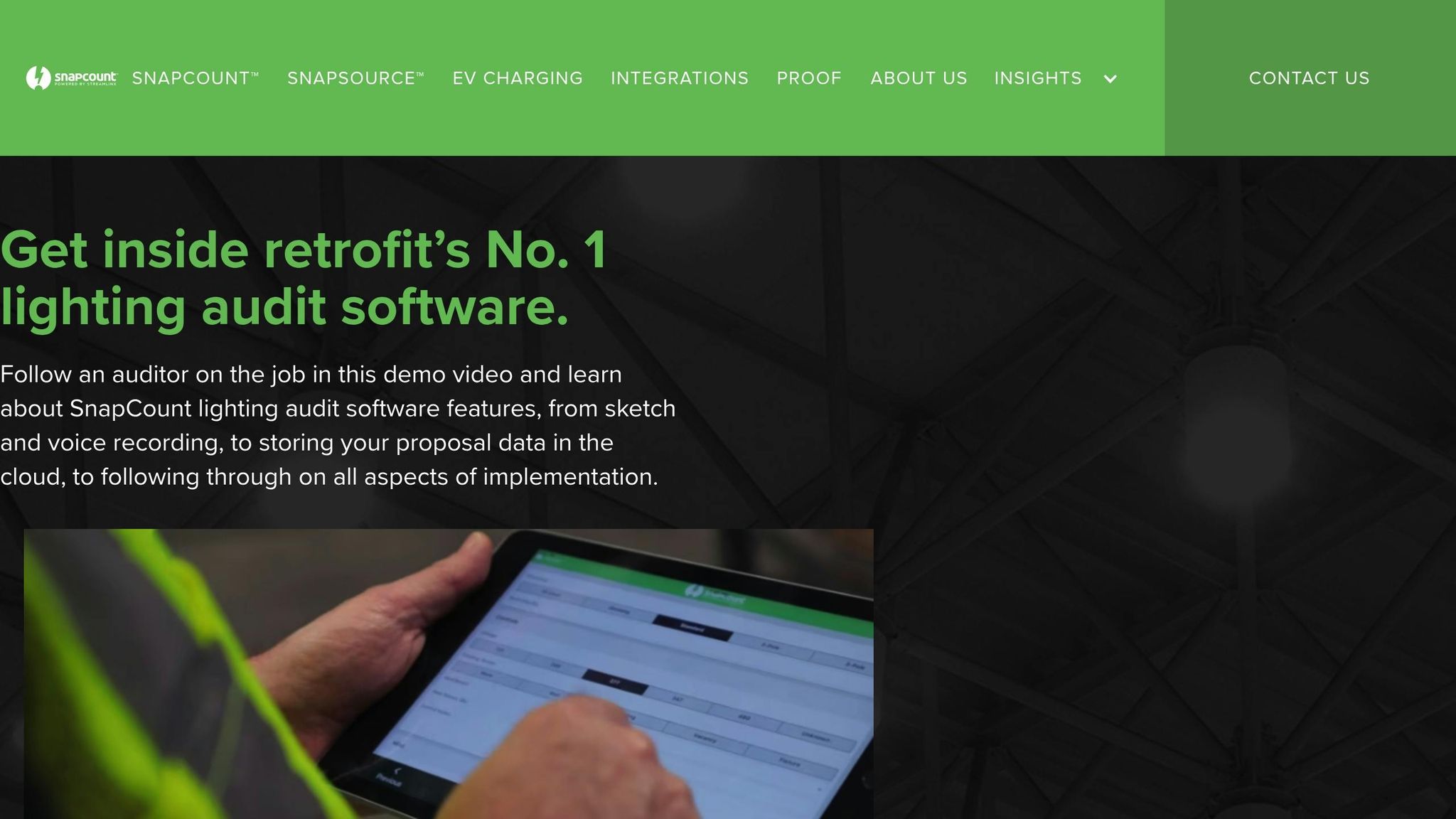
SnapCount takes the hassle out of manual data collection by offering a mobile app designed for tablets and smartphones. Auditors can log essential details like fixture type, quantity, operating hours, and mounting height directly on-site, eliminating the need for pen-and-paper methods. The app also includes a visual mapping feature, allowing users to attach photos, voice notes, blueprints, and hand-drawn sketches to specific areas or fixtures. This creates a detailed digital record of the facility.
The platform’s SnapSource Product Hub further simplifies the process by automating product selection. Instead of relying on outdated spreadsheets, it uses a searchable database updated with current market data to recommend the best products. Steven Kopf from Palmetto Green highlighted the time savings:
"It takes us 1-2 hours to produce the proposal now versus 4-6 hours before. With SnapCount, I conduct an audit, get dinner, and have the proposal done before my head hits the pillow."
This level of data collection and organization makes SnapCount especially effective for managing large, complex industrial facilities.
SnapCount doesn’t just gather data - it ensures smooth operations even in challenging environments. The platform’s offline functionality allows auditors to work seamlessly in areas with poor or no internet connectivity. When the device reconnects to the internet, all data automatically syncs to the cloud. Its Operations Module also tracks materials, labor, and daily progress, ensuring accuracy and consistency across large, multi-site projects. For example, Rogers Electric tripled its speed and retrofit capacity, while Graybar saw a 25% jump in project win rates using SnapCount.
The platform also supports national account rollouts and portfolio-wide analysis, making it a practical choice for companies managing multiple facilities. These features ensure that even the most complex projects stay on track.
SnapCount goes beyond operations by streamlining financial analysis and rebate calculations. Through its partnership with Encentiv Energy, the platform incorporates the Encentivizer tool, which instantly calculates utility rebates and incentives. This feature allows auditors to provide accurate ROI projections that account for available rebates. Reg Cook from Hemma Lighting shared his experience:
"The Encentivizer rebate tool is great. Once your data is set up, it quickly gives you accurate rebate estimates you can use in proposals and impress your clients."
SnapCount also generates customizable proposals that include detailed financial breakdowns, cash flow projections, and environmental impact metrics. For investment-grade projects and Energy Service Performance Contracting (ESPC), the platform provides reliable calculations that meet regulatory standards. Users have reported increased accuracy, improved efficiency, and revenue growth of over 30%, along with a 50% higher project win rate compared to traditional methods.
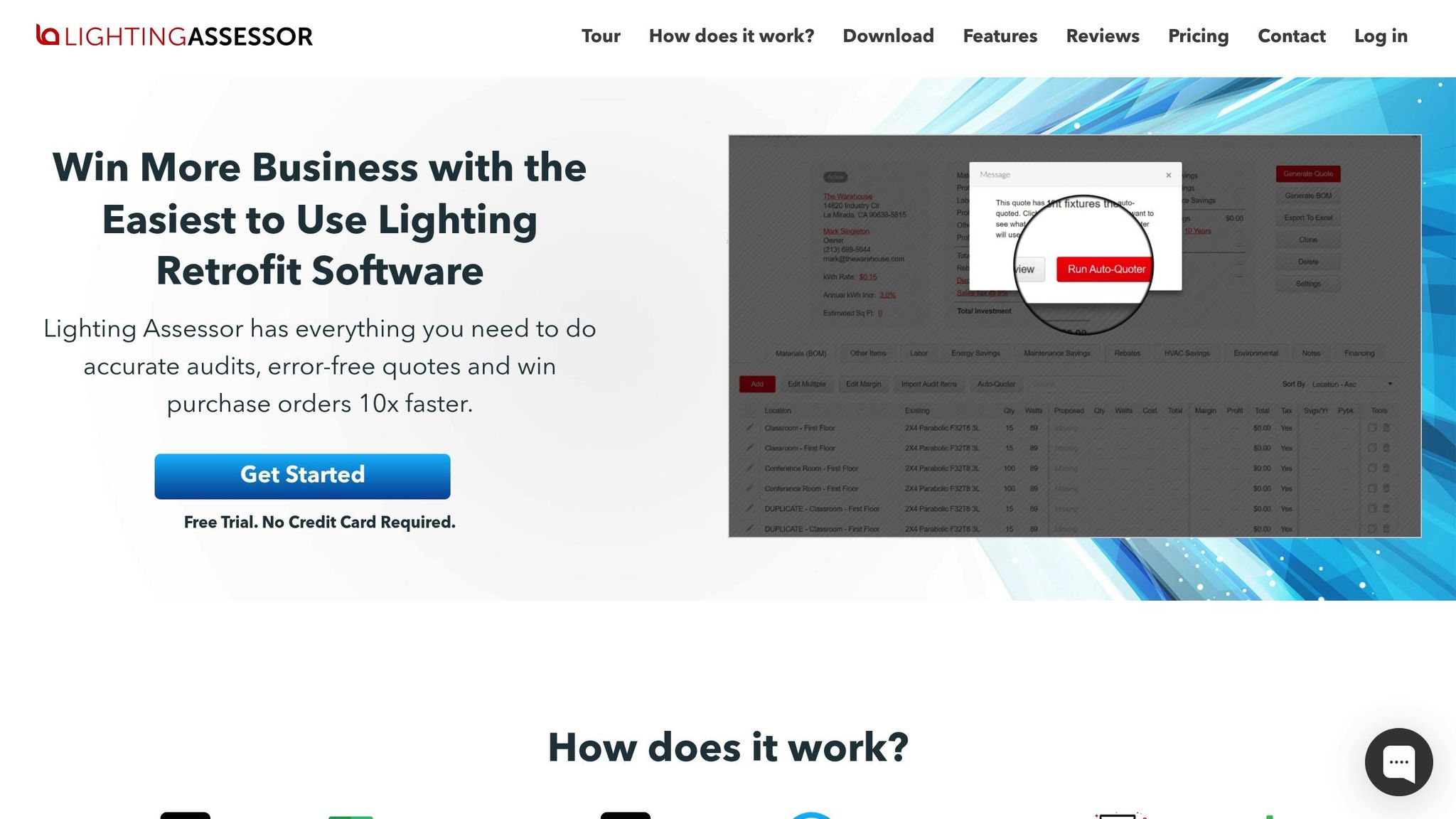
Lighting Assessor stands out with its ability to deliver accurate data while keeping costs manageable. Designed with a mobile-first approach, it works seamlessly on iOS and Android devices, making field audits much simpler. Auditors can log fixture details directly on-site using the app, which includes built-in libraries to help with quick identification. Even in areas with limited connectivity, the offline mode ensures uninterrupted data collection. Once the audit is complete, syncing the data is effortless - users can export it to Excel or a cloud-based quoting tool with a single click. This streamlined process also generates product specifications and branded proposals for clients.
The platform’s mobile-first design is a game-changer for large-scale operations. Its Manager Portal allows teams to coordinate multiple auditors at once, ensuring every corner of industrial facilities is covered efficiently. The intuitive design means minimal training is needed, so teams can get to work right away. Karl, a VP of Operations with over 30 years of experience in energy efficiency, praised the software as:
"one of the best decisions"
his business ever made. Industry professionals managing multi-million-dollar retrofit projects have also highlighted how well the software scales for large lighting contracting operations. This efficiency not only simplifies fieldwork but also strengthens financial analyses and rebate processes.
Lighting Assessor includes tools like the "Margin Maximizer", which automates financial analysis to ensure projects remain profitable before quotes are even issued. The platform quickly generates detailed product specs, branded documents, and energy savings projections. Pricing is flexible: users can start with a free trial that includes the mobile app and two free quotes. For ongoing use, there's a monthly plan at $129 or an annual plan at $1,299 - offering about 15% savings. Group discounts are also available for larger teams, making it a cost-effective choice for businesses of all sizes.
ecoInsight takes audit efficiency to another level by blending advanced digital tools with streamlined processes.
ecoInsight uses iPad-based data capture and cloud technology to speed up audits significantly. Its interactive "Pin It" feature allows auditors to mark fixture locations directly on digital floor plans, while the Fixture Wizard simplifies wattage calculations and suggests suitable replacement fixtures. To ensure thoroughness, the Comprehensive Audit Checker flags missing data, reducing the risk of costly revisits. The platform also connects to a cloud-based specification system, offering access to product data from over 300 manufacturers. According to users, this tool has cut audit times by over 50% compared to manual methods.
ecoInsight is built for large industrial settings, offering multi-auditor support so teams can collaborate on a single project in real-time. Ron Rye, Chief Operating Partner at LionLux Facility Solutions, shared:
"The software's comprehensive features, such as the interactive floor plan, intuitive fixture wizard, and detailed specification options, have enabled our team to tackle lighting projects with greater precision and ease."
Additionally, automated data transfers eliminate manual entry errors by seamlessly moving information into the design application. This integration allows for instant and accurate payback analysis, making the tool particularly valuable for industrial-scale projects.
ecoInsight simplifies energy savings calculations and payback analysis by replacing manual spreadsheets with automated tools. Users can compare up to three retrofit proposals side by side, helping them identify the option with the highest return on investment. Mike Morris, President of MM Energy Solutions, LLC, praised the platform:
"EcoInsight's lighting retrofit software has been a game-changer for us. The platform is user-friendly, reliable, and has significantly streamlined our retrofit process from start to finish."
The software also generates customizable submittal packages to document project specifications, which is crucial for utility rebate applications. For more complex retrofits, the platform offers on-demand value engineering services to help reduce costs and boost savings.
Luminate Lighting Group has reimagined the lighting audit process for industrial facilities by incorporating advanced digital tools. Instead of relying on outdated, paper-based assessments, they use platforms like SnapCount and ecoInsight to log fixture details, quantities, and operational hours directly on-site. This streamlined, tech-driven approach allows auditors to quickly gather data, including tagged photos and floor plans, which are instantly uploaded for analysis. The result? A significantly faster and more efficient audit process.
Proposals that used to take weeks can now be delivered in just hours. Steve LoJacono from Graybar explains the impact:
"SnapCount has eliminated any need for a paper-based facility assessment through its data gathering and mapping/pinpointing. It's all of our assessment and retrofit information in one place, one platform".
Luminate takes this further by integrating the collected data into custom proposals tailored to each facility's unique requirements, ensuring precision and relevance.
But the support doesn’t stop at data collection. Luminate Lighting Group provides detailed lighting layouts and photometric analyses, offering a clear visualization of how the upgraded lighting will perform. They also calculate energy savings using real-world data, presenting clients with clear payback timelines and ROI projections. To minimize disruptions, their installation teams work during nights and weekends, managing every aspect of the project from the initial audit to the final installation. On top of that, they simplify rebate calculations, making projects even more cost-effective.
Utility rebates and federal incentives are another key component of Luminate’s process. By using tools like Encentivizer within SnapCount, they quickly identify and calculate available incentives - such as Oncor rebates - which can reduce project costs by thousands of dollars before installation begins. This ensures clients benefit from every possible cost-saving opportunity without the hassle of additional research or paperwork.
To make the process even more accessible, Luminate offers a free initial assessment. This first step introduces clients to their seamless, end-to-end digital audit experience, guiding them through energy analysis, rebate applications, and compliance with energy-saving standards.
Specialized audit tools are changing the way industrial facilities approach lighting system evaluations and upgrades. Platforms like SnapCount and Retrolux simplify the process by cutting out manual errors and eliminating duplicate data entry, making data collection much more efficient. At the same time, tools like light meters provide precise foot-candle readings, which are essential for projecting realistic energy savings. Frank Agraz, Director of Engineering at Facility Solutions Group, highlights that using advanced digital audit platforms can increase accuracy, improve efficiency, and even drive revenue growth by up to 30%.
The financial advantages don’t stop there. These platforms also play a key role in qualifying facilities for utility rebates by documenting existing conditions with verifiable data. Additionally, the detailed insights they capture allow for accurate ROI calculations and payback period estimates, giving decision-makers the clarity they need to confidently invest in lighting upgrades.
From initial assessment to final installation, this digital-first approach ensures precise data collection, maximized rebates, and minimal operational disruption. With these tools and expert guidance, facilities can cut energy costs, enhance lighting performance, and stay compliant with code requirements.
A platform like SnapCount is a game-changer for managing energy audits across multiple industrial facilities. It streamlines the entire process by offering tools for centralized management, multi-site analytics, and automation. These features make data collection and reporting much easier, which is especially useful for large-scale operations.
Using a light meter can be incredibly helpful during an LED retrofit audit. It provides precise measurements of light levels, ensuring the lighting system not only meets performance benchmarks but also delivers the desired results effectively.
These tools help boost ROI by pinpointing energy savings, monitoring real-time energy usage, and leveraging incentives such as rebates and tax deductions. By combining these elements, they lower initial expenses and increase overall financial gains.


