.svg)
Why lighting compliance packages vary by jurisdiction — code edition, compliance path, and local forms that change reporting.

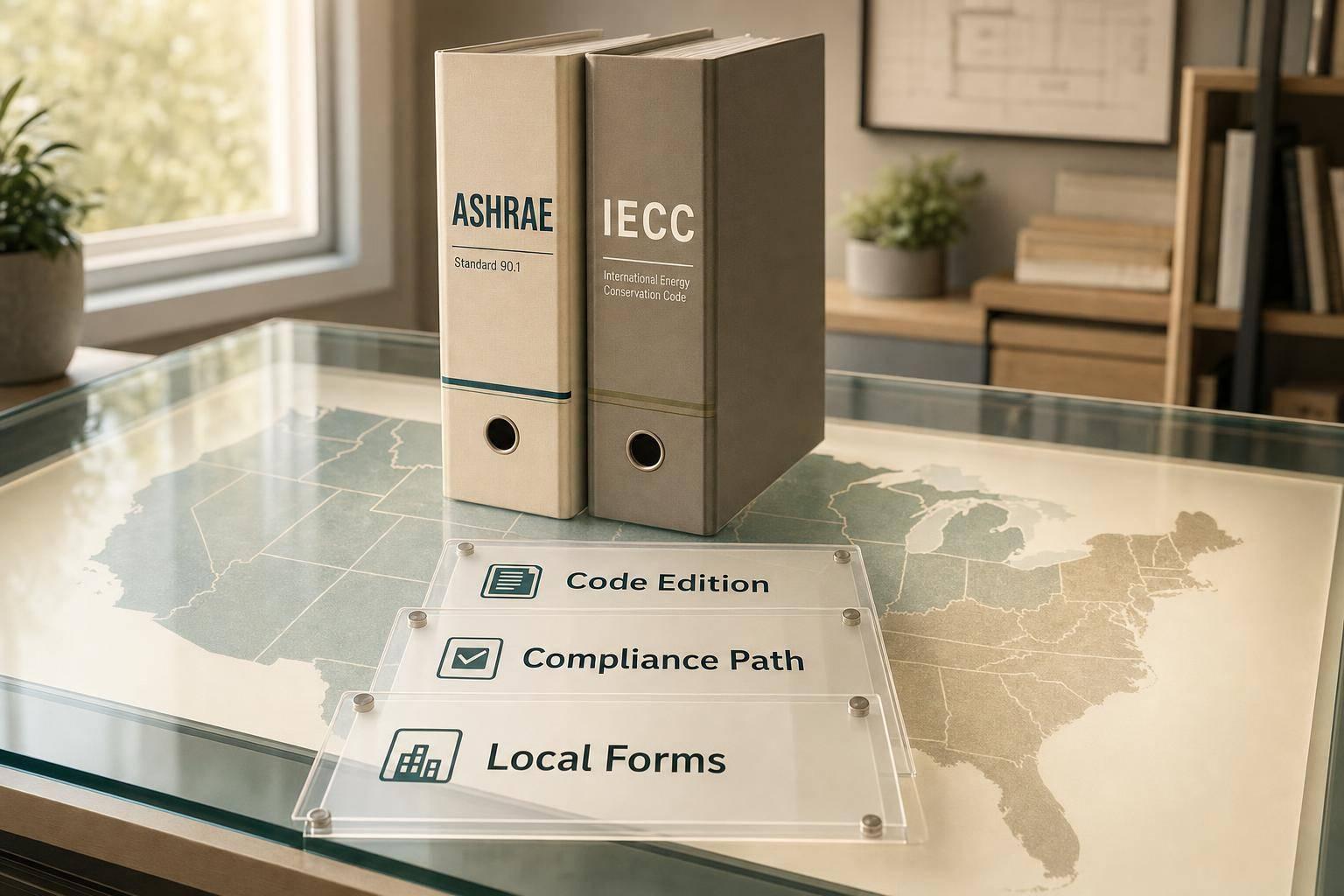
The short answer: your lighting report changes by location because states and cities adopt different energy codes, different editions, and different local forms.
If I had to sum up the article in a few lines, I’d say this:
In plain English: you can’t reuse the same package in every U.S. jurisdiction and expect approval.
| Topic | ASHRAE 90.1 | IECC |
|---|---|---|
| Main focus | More system-based rules | Broader building code approach |
| Building type | Commercial | Residential and commercial |
| Lighting path | Section 9 rules, plus performance options | Prescriptive, performance, or ASHRAE alternate path |
| Reporting style | More tied to system details and control requirements | More tied to forms, fixture schedules, narratives, and local code process |
| Regional issue | Edition and local amendments change what must be shown | Edition, local adoption, and alternate path choice change the package |
A few examples from the article show how uneven the map is: Oklahoma still points to much older code editions, while California uses Title 24, and places like Oregon, Vermont, Massachusetts, and New York may add state or local paperwork on top.
So before design, bidding, or ordering fixtures, I’d do one thing first: check the adopted code edition and local amendments with the AHJ. That one step shapes the calculations, forms, controls, and approval path for the whole job.
ASHRAE 90.1 is more prescriptive and system-specific. The IECC takes a broader, more performance-based approach. In plain English, ASHRAE 90.1 tends to tell you what each system must do, while the IECC puts more weight on how the building performs as a whole.
That difference shapes our process for lighting solutions and the reporting package from day one. Depending on the path, the submittal may lean on code tables, short narratives, or full energy modeling.
| Feature | ASHRAE 90.1 | IECC (Commercial) |
|---|---|---|
| Compliance Paths | Prescriptive, Energy Cost Budget, or Performance Rating Method (Appendix G) | Prescriptive, Total Building Performance, or ASHRAE 90.1 alternative path |
| Lighting Documentation | Detailed Section 9 requirements, including mandatory labeling and control diagnostics | Fixture schedules, LPD calculations, control narratives, and commissioning reports |
| LPD Calculations | Specific system-level LPD inputs | LPD values that vary by code edition |
On the prescriptive path, each part of the design has to meet the values listed in the code tables. Both frameworks set lighting power density, or LPD, limits and require lighting controls under their mandatory provisions. ASHRAE 90.1 lays out tighter system-level rules, while the IECC leaves a bit more room in how those rules are applied.
Those mandatory provisions still apply no matter which path you choose. So even if a team uses a performance method, basic control functions and minimum equipment efficiency levels still have to be met under both frameworks. If a project can't hit the prescriptive limits directly, the reporting package shifts toward a performance method instead.
When a project needs more design flexibility, the performance path allows trade-offs between systems. ASHRAE 90.1 includes the Energy Cost Budget method in Section 12 and the Performance Rating Method in Appendix G. The IECC uses the Total Building Performance method.
This is where the paperwork gets heavier. A performance-path submittal usually includes energy modeling summaries, detailed assumptions, and narratives that explain where the building beats code and where trade-offs make up for weaker spots. The path you pick drives the calculations, assumptions, and written explanations in the final package.
IECC Section C401.2.2 lets a project team comply with the IECC by following ASHRAE 90.1 instead. That choice should be made early. If the team switches direction late, the documentation can drift out of sync fast.
Once a jurisdiction adopts a given code edition, the reporting package has to match that edition from the first design submittal. That's the part that can trip teams up: the rules are not just about what you submit, but which code version those documents point to.
"Because jurisdictions adopt different editions and may prioritize ASHRAE 90.1 as an alternative compliance path, careful alignment with local code adoptions is essential to avoid design errors and rework." - CDM Smith
The selected compliance path must stay aligned with that standard.

ASHRAE 90.1 vs. IECC: U.S. Regional Energy Code Compliance by State
Once you’ve picked the compliance path, the next thing that can trip up a project is the jurisdiction’s adopted code edition and any local amendments.
This is where things start to split fast. A submittal that works in one state, or even one city, can get kicked back somewhere else. The reason is simple: adopted editions differ across the country, and local governments often layer on their own forms and rules.
Here’s how that looks in practice:
| State | Primary Commercial Code | Notable Variation |
|---|---|---|
| California | Title 24, Part 6 (2022/2025) | Demand-responsive lighting; extra state forms required |
| Massachusetts | IECC 2021 + Stretch Code | Stretch-code submittals with additional documentation |
| Florida | ASHRAE 90.1-2019 | Based on the 8th Edition Florida Building Code |
| New York | IECC 2018 / ASHRAE 90.1-2016 | NYStretch-2020 adopted by 42+ local governments, including NYC |
| Oregon | ASHRAE 90.1-2019 | Requires Oregon Zero Energy Ready Compliance Form and ZERO Code Calculator report |
| Oklahoma | IECC 2006 / ASHRAE 90.1-2003 | Among the oldest codes still in use; significantly less stringent documentation |
Some states use ASHRAE 90.1 as the main commercial code. And in home-rule states, state code may be only part of the story. A city may ask for its own forms instead of relying on state standards alone.
After code adoption, reporting differences often show up in daylighting and control submittals.
Climate zones play a big part here. Under ASHRAE 90.1 and the IECC, automatic lighting controls are required. But newer editions tend to ask for more detail, which means the paperwork gets tighter too.
For daylit spaces, submittals under newer editions may need:
There’s also a shift in how controls are expected to perform. Newer codes often call for continuous daylight dimming instead of stepped switching. Occupancy sensor timeouts are also getting shorter, moving from 20 minutes down to 15 minutes in recent editions. That may sound minor, but it’s the kind of detail that can force a resubmittal if a jurisdiction has already moved to the newer rule set.
Even when two jurisdictions use the same code edition, the submittal format may still be different.
COMcheck, whether Web or Desktop, is a standard tool in many places. But it doesn’t always cover everything a local office wants. Some jurisdictions require extra forms that COMcheck does not produce by itself. Oregon is a good example. In addition to the standard energy compliance package, it requires an Oregon Zero Energy Ready Compliance Form and a ZERO Code Calculator report.
Vermont takes a different route. It requires certification signed by both the primary designer and the builder. Some jurisdictions also add operational compliance programs that go beyond the permit package. And if the adopted code changes, an old COMcheck report can slow approval or send the project back for resubmittal.
The safest move is to pull the local permitting checklist before the package is finalized. If a jurisdiction-specific form is missing, approval can stall. On any project, the local checklist sets the final submittal package.
Once the adopted code and any local amendments are confirmed, the reporting package needs to line up with them exactly.
A complete lighting reporting package covers three basic things: what’s installed, how much power it uses, and how the system operates.
Fixture schedules list each luminaire by type, quantity, and wattage. Lighting Power Density (LPD) calculations show that watts per square foot, by space type, stay within the code limit. Control narratives explain how each zone functions in practice, including occupancy sensor timeout settings, daylight dimming sequences, and schedule setup. Use COMcheck to document LPD compliance and any selected efficiency credits.
For buildings over 25,000 sq ft under ASHRAE 90.1-2019/2022 or the 2021 IECC, and over 10,000 sq ft under the 2024 IECC, include EMCS documentation for separate interior and exterior lighting monitoring. That drop in the threshold under the 2024 edition matters a lot. Whether EMCS documentation is required comes down directly to the code edition adopted by the jurisdiction.
| Document Category | Required Items | Code Reference |
|---|---|---|
| Core Design | Fixture schedules, LPD calculations, control narratives | ASHRAE 90.1 Sec 9 / IECC C405.3 |
| Monitoring | 15-minute interval data, 36-month storage, graphical interface | ASHRAE 90.1 Sec 8 / IECC C405.12 |
| Verification | Functional testing, commissioning certificates | ASHRAE 90.1 Sec 4.2.5 |
These documents show design intent. Commissioning shows the system was installed and set up the way it was supposed to be.
ASHRAE 90.1-2022 Section 4.2.5 requires functional testing reports and commissioning certifications aligned with ASHRAE 202. In plain terms, this can’t be treated like a last-minute paperwork scramble before the Certificate of Occupancy. It needs to be part of the project schedule from day one. Newer adopted editions tend to be stricter, so the format and level of detail in commissioning records can shift from one jurisdiction to another.
Meter data also needs attention. Keep it for 36 months at 15-minute intervals, and summarize it on an hourly, daily, monthly, and annual basis. Those records can also help during utility rebate audits and for 179D tax deduction documentation.

On multi-site work, a repeatable documentation process helps keep AHJ submittals in sync. Luminate Lighting Group can help organize lighting submittals, layouts, and control documentation for multi-region code review.
ASHRAE 90.1 and IECC are not interchangeable. One code path needs to govern the entire project. That’s why early alignment matters.
Lock the compliance path during schematic design, then confirm it with the AHJ before submittals. After that, the reporting work changes based on local adoption.
Regional adoption shifts what needs to go into the reporting package. So even when the lighting scope stays the same, the forms, calculations, and control details can change from one jurisdiction to another. The smart move is to build a repeatable package, not a brand-new process for every job.
For multi-state portfolios, use one core reporting template and then tailor it to the adopted code and local climate-zone rules.
Luminate Lighting Group helps organize lighting submittals, layouts, and control documentation so each AHJ package matches the right code path.
The energy code that applies to your project depends on the city, county, or state where the building sits. In many cases, IECC is the starting point. But plenty of jurisdictions use their own adopted edition of IECC, ASHRAE 90.1, or a mix of both.
It’s smart to check with your local building official or inspector before you move too far. They have the final say on permitting and the certificate of occupancy. Luminate Lighting Group can help you sort through these regional code requirements.
Contact the local building department or building inspector in the area where the project will be built. They’re the final authority on which energy code edition you need for permit approval.
States and cities don’t always follow the same edition, and some add local amendments on top of it. That’s why it makes sense to check the code during schematic design, not later when changes get more expensive and annoying.
If the project uses federal financing, you may also need to meet specific federal standards.
COMcheck is a simplified compliance tool. That makes it useful for straightforward jobs, but it may not be enough when a project has more complex demands or when a jurisdiction asks for deeper reporting.
It can verify basic code compliance. But it often falls short when a project includes advanced energy monitoring, submetering mandates, or performance-based requirements that go beyond standard prescriptive paths.
It may also miss stricter local stretch code requirements. In plain terms, a project can look fine in COMcheck and still need more documentation or a different review path to satisfy local rules.


