.svg)
Summary of ASHRAE 90.1 updates, compliance paths (prescriptive, Appendix G, TSPR), EMCS monitoring, and HVAC efficiency steps.

ASHRAE Standard 90.1 sets the energy efficiency baseline for HVAC systems in commercial buildings across the U.S. It focuses on reducing energy costs, improving system performance, and integrating advanced controls. Key updates in the 2025 edition include stricter HVAC requirements, increased renewable energy capacity, and mandatory energy monitoring for larger buildings. Compliance can be achieved through prescriptive, performance-based, or TSPR pathways, each offering different levels of flexibility and complexity. Proper system operation, regular monitoring, and energy audits ensure long-term efficiency and compliance.
Key Takeaways:
Always verify the adopted ASHRAE edition for your project to avoid costly revisions.
ASHRAE Standard 90.1 forms the backbone of energy policies for commercial buildings in the U.S. Its full name - "Energy Standard for Sites and Buildings Except Low-Rise Residential Buildings" - lays out the minimum energy efficiency requirements for commercial and industrial structures. Under the U.S. Energy Policy Act of 2005, it serves as the baseline for all new federal buildings, and it’s the technical foundation for nearly all state and local energy codes.
"ASHRAE 90.1 is the energy efficiency standard that governs virtually every commercial building in the United States." - Envigilance
This standard applies to new construction, building additions, and upgrades to systems like HVAC, lighting, and controls. Its reach extends beyond the building itself, covering aspects like parking lot lighting and on-site renewable energy systems. However, it excludes single-family homes, low-rise multifamily buildings, and manufactured homes.
This wide scope is crucial because buildings account for about 76% of electricity use and approximately 40% of primary energy consumption in the U.S.. With such a significant footprint, a standard that influences nearly every commercial project can have a massive cumulative effect on national energy use. These broad guidelines pave the way for meaningful updates in the upcoming 2025 edition.
The 2025 edition introduces several impactful changes, particularly in HVAC efficiency. Among the 105 addenda included, key updates feature:
A major shift in this edition is the requirement for operational verification. Compliance now extends beyond design - buildings over 25,000 sq. ft. must implement an Energy Management Control System (EMCS) to monitor electrical loads (like HVAC, lighting, and plug loads) at 15-minute intervals, with data retention for 36 months. Additionally, buildings must earn extra efficiency credits by choosing from 33 measures outlined in Section 11. These measures include options like improving the building envelope or enhancing HVAC system performance. The goal is to ensure that systems operate efficiently long after installation.
Before finalizing designs, always verify which version of the standard has been adopted by the Authority Having Jurisdiction (AHJ) to avoid costly revisions.
ASHRAE standards do more than just set efficiency benchmarks - they shape how HVAC systems are designed, chosen, and operated from the very start. Section 6 of Standard 90.1 is the key mechanical chapter, laying out minimum efficiency requirements for major equipment categories like chillers, boilers, heat pumps, packaged rooftop units, and variable refrigerant flow (VRF) systems. The specific equipment requirements depend on the climate zone. For example, a rooftop unit in Phoenix must meet different efficiency levels than one in Minneapolis.
One common issue is mismatched efficiency metrics on equipment schedules. These metrics must match the adopted code version. For instance, the 2022 edition replaced SEER/HSPF metrics with SEER2/HSPF2 for smaller air-cooled heat pumps (under 65,000 Btu/h) to better reflect real-world installation conditions.
But efficiency ratings are only part of the equation; HVAC design must also ensure occupant health and comfort.
Two other ASHRAE standards complement 90.1 to provide a complete picture of HVAC performance. ASHRAE Standard 62.1 specifies the minimum outdoor air (OA) ventilation rates needed to maintain indoor air quality and protect occupant health. Meanwhile, Standard 55 defines the thermal conditions - like temperature, humidity, and air speed - that ensure occupant comfort. The challenge? Balancing both standards. Too little outdoor air saves energy but risks poor air quality, while too much increases heating and cooling demands.
This is where Demand-Controlled Ventilation (DCV) becomes a useful approach. Instead of maintaining fixed maximum outdoor air levels, DCV uses CO₂ sensors to adjust airflow based on actual occupancy. It’s required for spaces with a design occupancy of 25 people or more per 1,000 sq ft, and in suitable climates, it delivers real savings. For example, DCV can cut outdoor air energy use by 20% in Climate Zone 3 office buildings.
ASHRAE 90.1 places a strong emphasis on controls to ensure efficient day-to-day operations. For buildings with direct digital controls (DDC), Section 6 requires features like automatic setback, optimum start, and zone-level isolation. These prevent HVAC systems from running at full capacity during unoccupied hours. Permit reviewers specifically look for these features in design drawings.
"If a reviewer has to infer compliance from scattered notes, expect an RFI or correction notice." - BIM Heroes
The 2022 edition also introduced a requirement for automated Fault Detection and Diagnostics (FDD) in economizers. Economizers use outdoor air for "free cooling" when conditions allow, but without FDD, issues like stuck dampers can go unnoticed, wasting energy and reducing comfort. For buildings over 25,000 sq ft, all of this ties into the mandatory Energy Management Control System (EMCS). These systems track HVAC energy use in 15-minute intervals. Research shows that buildings often consume 20–30% more energy than their design models predict, and continuous monitoring is now a required step to bridge that gap.
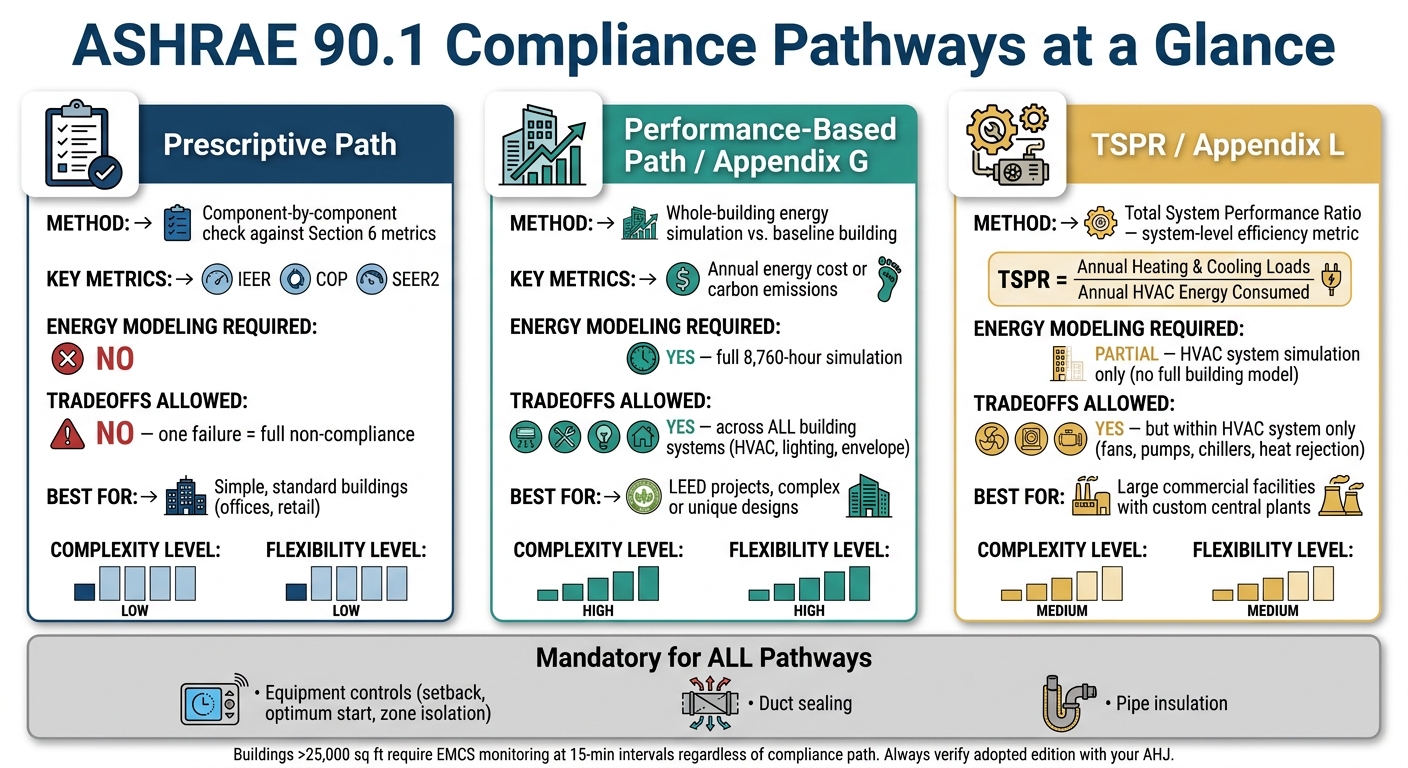
ASHRAE 90.1 Compliance Pathways Compared: Prescriptive vs. Performance vs. TSPR
Once you've addressed the HVAC design considerations, the next step is selecting a compliance pathway that aligns with ASHRAE Standard 90.1. Choosing the right path early can save both time and money during the plan review process. Regardless of the path you choose, certain mandatory provisions - like equipment controls, duct sealing, and pipe insulation - apply across the board.
The prescriptive path offers a simple and straightforward option. Under this approach, each piece of equipment must meet efficiency metrics outlined in Section 6, such as IEER, COP, and SEER2. The upside? No energy modeling is required. The downside? Zero flexibility. If even one component falls short, the entire project fails to comply. This method is ideal for straightforward projects like standard office buildings, retail spaces, or other designs with conventional HVAC systems.
"The prescriptive path (Section 6) is deterministic yet rigid... Teams using energy modeling under Appendix G gain flexibility to underperform on individual HVAC metrics if other systems compensate." - HVAC Compliance Authority
The performance-based path, on the other hand, follows Appendix G or the Energy Cost Budget method. Instead of evaluating each component individually, this approach uses a whole-building energy simulation to compare the proposed design against a baseline building defined by the code. This allows for tradeoffs - for instance, an efficient lighting system or a highly insulated building envelope can offset HVAC equipment that doesn’t meet prescriptive minimums. However, the tradeoff is cost and complexity: full compliance requires an 8,760-hour energy simulation. This path is best suited for LEED-certified projects or buildings with unique or complex designs.
| Feature | Prescriptive Path | Performance-Based Path (ECB/PRM) |
|---|---|---|
| Method | Component-by-component check | Whole-building energy simulation |
| Tradeoffs | Not allowed | Allowed between all building systems |
| Modeling Required | No | Yes - full 8,760-hour simulation |
| Best For | Simple, standard buildings | LEED projects, complex designs |
| Primary Metric | IEER, COP, SEER2, etc. | Annual energy cost or carbon emissions |
For projects needing internal tradeoffs within HVAC systems, the TSPR method provides a practical alternative.
The Mechanical System Performance Rating method, introduced in the 2022 edition of ASHRAE Standard 90.1, offers a middle ground through the Total System Performance Ratio (TSPR). This system-level efficiency metric focuses exclusively on the mechanical systems, providing some flexibility without requiring a full building energy model.
TSPR is calculated by dividing a building's annual heating and cooling loads by the annual energy consumed by the entire HVAC system, which includes fans, pumps, and heat rejection equipment. A higher TSPR score indicates better system efficiency. Compliance is achieved if the proposed design's TSPR meets or exceeds the reference building's TSPR, adjusted by a Mechanical Performance Factor (MPF).
"TSPR evaluates the resources required for an HVAC system to fulfill the function for which it is intended - meeting building sensible and latent loads." - Building Energy Codes Program
One of TSPR’s key benefits is the flexibility it offers within the mechanical system itself. For example, a highly efficient central chiller plant can offset a terminal unit that falls short of prescriptive requirements, all without needing a whole-building energy model. However, this flexibility is limited to the HVAC system - tradeoffs cannot extend to other building components like the envelope or lighting.
"The constraint is you can only trade within the HVAC system. No swapping a better chiller for a worse envelope. Those have different lifespans (15 years versus 40+ years), and the committee finally acknowledged that matters." - Better Building Docs
For large commercial facilities with custom central plants, the TSPR path often strikes the right balance between the rigidity of prescriptive compliance and the complexity of full energy modeling. To simplify this process, PNNL (Pacific Northwest National Laboratory) has developed tools to automate the Appendix L simulation requirements, making TSPR calculations more accessible for design teams.
Whether you're following the prescriptive path, the performance path, or TSPR, achieving efficiency relies on proper equipment setup, well-tuned controls, and consistent performance checks.
Once you've chosen a compliance pathway, keeping things running smoothly is key to maintaining efficiency over time. The real challenge lies in operational performance, not just meeting design standards. Without proper monitoring, issues like stuck dampers, drifting sensors, or overridden control sequences can creep in, leading to unnecessary energy consumption.
"Design compliance alone fails to guarantee operational performance – the standard now recognizes that continuous verification is essential." - U.S. Department of Energy
ASHRAE 90.1-2022 addresses this issue head-on. For buildings over 25,000 square feet, Section 8 now requires Energy Management Control Systems (EMCS) to monitor HVAC, interior lighting, exterior lighting, and plug loads. These systems must collect data at 15-minute intervals and store it for at least 36 months. This isn't just about record-keeping - it sets the stage for Fault Detection and Diagnostics (FDD). FDD can identify problems like stuck economizer dampers or faulty sensors early, before they quietly waste energy for months.
Buildings with continuous monitoring often recover 15% to 30% of wasted energy. Regular calibration of sensors and periodic reviews of control systems can keep everything running efficiently at a relatively low cost. This approach complements the tradeoffs in the TSPR methodology, helping mechanical systems deliver the performance they were designed for throughout their lifespan.
To ensure long-term efficiency gains, pair HVAC upgrades with thorough energy audits. An ASHRAE-level energy audit helps prioritize upgrades for maximum impact and guides you toward the right compliance path. This is especially important for navigating Section 11 of the 2022 edition, which requires buildings to earn efficiency credits by selecting from 33 measures, such as ground-source heat pumps, improved envelope performance, or thermal energy storage.
One particularly effective strategy is combining HVAC upgrades with lighting retrofits. For example, under the performance-based path (Appendix G), upgrading to high-efficiency LED lighting reduces internal heat gains, which in turn lowers cooling loads. This means your HVAC system can be appropriately sized rather than oversized. Oversized systems, a common issue found during audits, can complicate economizer operation and make compliance more challenging. Companies like Luminate Lighting Group specialize in LED retrofits and energy audits, helping facilities optimize their performance while meeting ASHRAE standards.
Combining upgrades also opens the door to financial benefits. When lighting and HVAC improvements are completed together, they often qualify for utility rebates and tax deductions, such as the 179D deduction. These incentives may not apply if systems are upgraded separately. Conducting an audit before starting work ensures that every measure is sequenced for maximum efficiency, well-documented for plan reviews, and aligned to meet - or even surpass - ASHRAE 90.1 requirements.
ASHRAE 90.1 serves as the foundation for commercial HVAC energy compliance across the U.S. The 2022 edition marks a significant step forward, cutting energy costs by over 48% compared to 2004 levels. This progress comes from stricter equipment standards, advanced control systems, and mandatory operational monitoring.
Selecting the right compliance path is crucial. The prescriptive path is ideal for simpler projects, offering clear, predefined requirements. For more complex designs, the TSPR (Appendix L) and Performance Rating Method (Appendix G) provide flexibility, allowing teams to optimize the entire system. The choice of path should align with the project's complexity and specific building needs.
But efficiency doesn't stop at design. Proper system operation is just as important. Studies show that actual energy use can surpass modeled predictions by 20–30%. To address this, the 2022 edition requires continuous energy monitoring for buildings over 25,000 sq ft. Real-time data and fault detection help bridge the gap between predicted and actual performance.
The new edition also emphasizes reducing carbon emissions. It includes carbon emission factors and mandates on-site renewable energy generation of at least 0.5 W/sq ft for the first three floors.
"The 2022 edition now includes a methodology for using site and source energy cost in addition to carbon emission factors." - Bill Kosik, PE, CEM, LEED AP, BEMP
Before starting any design work, always verify which edition your Authority Having Jurisdiction (AHJ) has adopted. Adoption timelines vary by state, and designing to the wrong edition can lead to costly rework or permit delays. These highlights offer a concise guide to aligning HVAC designs with ASHRAE 90.1 requirements.
To determine which edition of ASHRAE 90.1 applies in your area, you'll need to check the energy code adopted by your local jurisdiction. Since states and cities often stick with older editions, there isn’t a universal standard across the country. For specific details, reach out to your local building department or state energy office. If you're looking for support, Luminate Lighting Group offers energy audits and lighting upgrades that align with the requirements in your area, helping ensure compliance.
Choosing the right path for ASHRAE 90.1 compliance hinges on your project's specific needs and complexity.
No matter which path you take, keep in mind that mandatory HVAC provisions apply across the board. These rules ensure a baseline level of efficiency and performance for all systems.
For buildings exceeding 25,000 square feet, ASHRAE 90.1-2022 Section 8 mandates the use of an Energy Management Control System (EMCS) to keep track of energy usage. This system must:
Luminate Lighting Group assists clients in meeting these standards by conducting audits and implementing energy-efficient upgrades tailored to their needs.


