.svg)
How ASHRAE 90.1 and the IECC differ across U.S. regions and what documentation projects need for approvals and rebates.

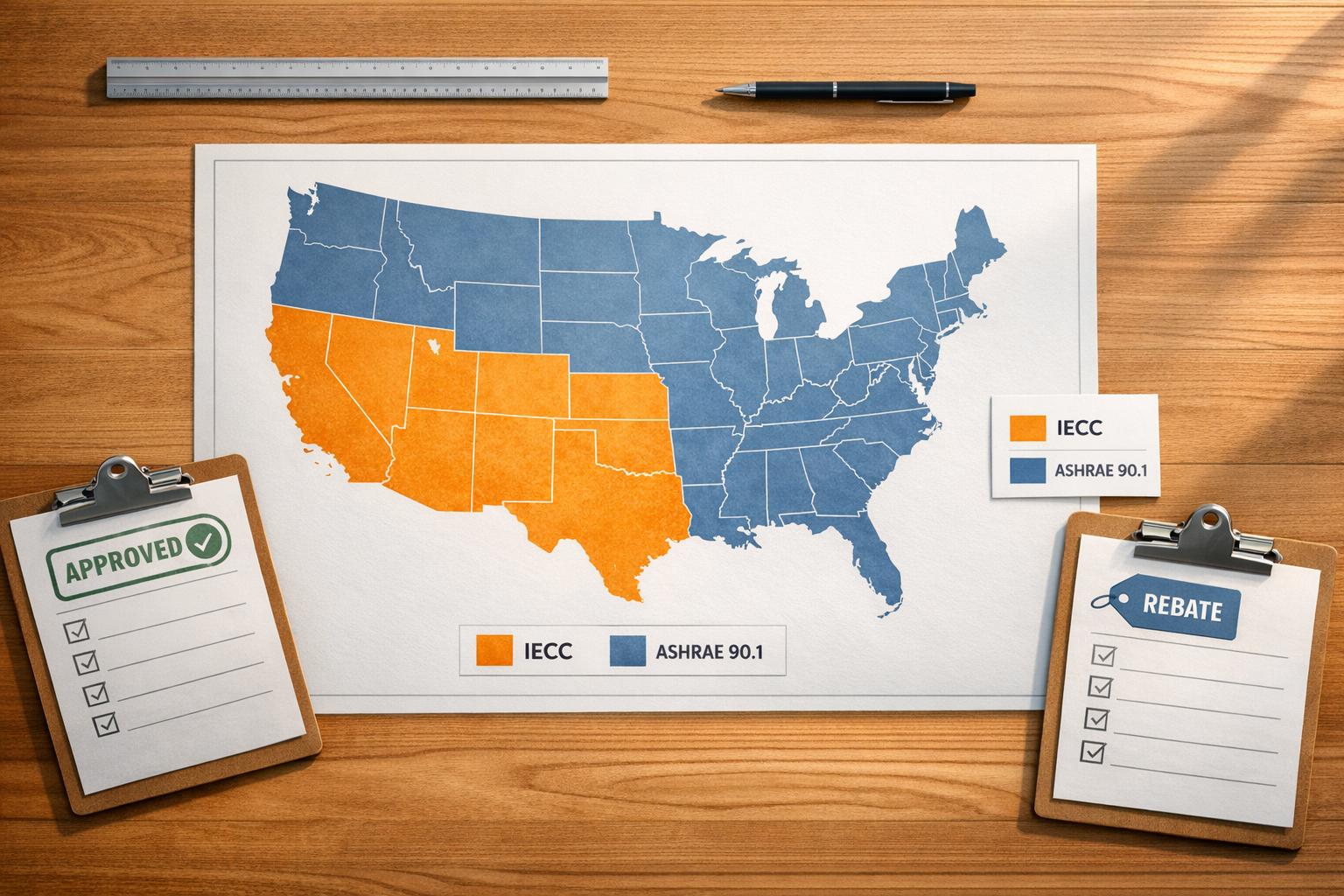
In the U.S., energy codes for commercial buildings vary significantly by region, with ASHRAE 90.1 and the IECC being the two main standards. Both aim to improve energy efficiency but differ in approach and documentation requirements. ASHRAE 90.1 is a technical standard with detailed compliance paths, while the IECC is a model code designed for flexibility. Regional climate, state policies, and local amendments further shape how these codes are applied, creating variations in documentation needs.
Key points:
Understanding these differences is critical for smooth project approvals and maximizing energy savings.

ASHRAE 90.1 and the IECC both rely on ASHRAE Standard 169, Climatic Data for Building Design Standards for their climate zone classifications. This system divides the U.S. into eight main climate zones, determined by factors like temperature, heating degree days, and cooling degree days. Zones 2 through 5 are further split into subdivisions - A (moist), B (dry), and C (marine) - to reflect differences in precipitation and humidity.
Before 2004, ASHRAE and IECC used more detailed systems, with ASHRAE defining 38 zones and IECC 33. The shift to a unified eight-zone system brought greater consistency, though updates continue. For instance, in 2021, around 10% of U.S. counties were reassigned to warmer climate zones. A notable example is southern Wisconsin, which moved from Zone 6 to Zone 5 under ASHRAE 90.1-2016.
ASHRAE's system spans from Zone 1 (the hottest areas like Hawaii and South Florida) to Zone 8 (subarctic conditions in interior Alaska). A newer Zone 0 was introduced to address extremely hot, tropical island climates. Each zone sets specific energy efficiency standards for building components like insulation, HVAC systems, and lighting. For example, required insulation R-values, solar heat gain coefficients (SHGC) for windows, and HVAC efficiency ratings vary by zone.
Susan Heinking, FAIA, NCARB, LEED Fellow at Pepper Construction, highlights why this system matters:
Our building codes have to match the environment in order for the systems to perform properly.
This approach ensures that a commercial building in Zone 2B (Phoenix) will have vastly different design requirements compared to one in Zone 6 (Minneapolis), even under the same version of ASHRAE 90.1.

The IECC uses the same climate zone map as ASHRAE but applies it differently. While ASHRAE 90.1 serves as a technical standard for commercial buildings, the IECC acts as a model code that states can adopt, modify, or amend. This flexibility means that although both use the same zones, their compliance tables and performance metrics differ.
California stands out as an exception to the national system. Instead of following the IECC/ASHRAE framework, the state uses Title 24, Part 6, a highly specialized energy code. Similarly, states like Washington and Oregon adopt the IECC but include state-specific amendments, leading to regional variations despite shared climate zones. To pinpoint a project's climate zone, professionals should rely on the U.S. Department of Energy's Building Energy Codes Program county lookup tool rather than generalized state maps.
These varying climate zone applications play a crucial role in shaping the documentation requirements covered in the next sections.

ASHRAE 90.1 vs IECC Commercial Building Energy Code Documentation Requirements Comparison
The paperwork needed for ASHRAE 90.1 and IECC compliance varies quite a bit, even though both aim to improve energy efficiency in buildings. ASHRAE 90.1 is a technical standard, while the IECC serves as a model code that states can adopt and modify to suit local needs. Patrick Chopson, Co-Founder of cove.tool, sums up their relationship:
The IECC is the model code and ASHRAE 90.1 is the standard upon which the model code is based.
This distinction helps explain how each code handles documentation.
Both ASHRAE 90.1 and the IECC offer multiple ways to demonstrate compliance, but their documentation approaches differ. ASHRAE 90.1 includes three main paths:
The IECC provides similar options but uses its own worksheets instead of ASHRAE's detailed Sequence of Operations (SOO) for each control zone. These differences reflect each code's adaptation to regional energy concerns.
When designers choose to follow ASHRAE 90.1 under IECC Section C401.2, they are required to meet all its standards for envelope, lighting, and mechanical systems. This "all-or-nothing" rule ensures designers can’t selectively pick requirements from each code.
Both codes require thorough modeling and testing, especially for performance-based compliance. ASHRAE 90.1 Appendix G uses a 2004 baseline and Building Performance Factor (BPF) to ensure consistency, while the IECC relies on its worksheets and total building performance calculations. ASHRAE 90.1-2019 also mandates commissioning based on ASHRAE/IES Standard 202, while IECC commissioning requirements vary depending on state-specific adoption.
Air barrier testing is another area where the two codes differ. Both allow material-based or blower door testing for air barrier verification. However, if a building fails blower door testing under either code, switching to material testing isn’t an option. ASHRAE 90.1-2016 allows air barrier exemptions for semi-heated spaces in Zones 0-6, while the IECC 2018 generally requires air barriers for all space types. For submetering, ASHRAE 90.1-2025 goes a step further by requiring systems that store hourly data for at least 36 months.
Here’s a quick look at the key documentation differences between ASHRAE 90.1-2022 and IECC 2024:
| Documentation Element | ASHRAE 90.1-2022 | IECC 2024 (Commercial) |
|---|---|---|
| Primary Documentation | Compliance forms and Sequence of Operations (SOO) | Dedicated worksheets and system records |
| Compliance Paths | Prescriptive, Envelope Trade-off, Energy Cost Budget | Prescriptive, Total Building Performance |
| Air Leakage Testing | Mandatory air barrier; testing optional/required by zone | Mandatory air barrier; blower door testing required for most |
| Submetering | Required for end-uses; 36-month data storage | Required for HVAC, lighting, and plug loads |
| Lighting Controls | Occupancy/Time-switch; detailed sequence required | Occupancy/Scheduling; broader space application |
| Receptacle Controls | 50% of 120V receptacles must auto-shutoff in offices | Often optional or handled via local amendments |
While ASHRAE 90.1 and IECC provide national frameworks, the specifics of documentation can shift significantly depending on the region. In the U.S., a three-tier system shapes these requirements: federal efficiency standards, state-level code adoption, and local amendments overseen by Authorities Having Jurisdiction (AHJ). This structure creates notable differences in documentation. For example, Seattle may demand more detailed paperwork than Oklahoma, even if both follow the IECC. Let’s look at how these layers translate into varying documentation expectations across different regions.
States in the Northeast often adopt the latest code versions and add extra layers of documentation. For instance, New York City's Energy Conservation Code (NYCECC) and Vermont's Commercial Building Energy Standards (CBES) impose stricter requirements than their respective state baselines. Michael Jouaneh, Manager of Sustainability and Energy Standards at Lutron, explains:
Local jurisdictions can choose to modify the state energy code to be more progressive and energy efficient than required by the state (e.g., New York, NY and Seattle, WA).
Vermont also offers its own compliance path for ASHRAE 90.1-2016. This path requires the primary designer to certify the design and the builder to provide a separate certification.
In the South, states often rely on older code editions, leading to lighter documentation demands. For example, South Carolina adheres to IECC 2009, while Oklahoma still uses IECC 2006. While these codes reduce paperwork, they can also result in fewer energy savings. Texas adds a unique twist, focusing heavily on ventilation calculations tied to floor area and occupant density under ASHRAE 62.1.
Additionally, federal SEER2 ratings for split-system central air conditioners vary by region. As of 2023, the rating is 13.4 in the northern U.S. but rises to 14.3 in the South and Southwest. Meeting these higher cooling efficiency standards requires additional mechanical system documentation. These challenges set the stage for even more complex requirements on the West Coast.
California leads the nation with its Title 24 energy code, which stands apart from ASHRAE 90.1 and IECC. Steve Shepherd from hi-hyperlite.com underscores this distinction:
Title 24 is mandatory for California projects and not interchangeable with 90.1 or IECC.
Title 24 requires the most extensive documentation in the country, including compliance forms, mandatory acceptance tests by certified professionals, and detailed system-level diagrams showing fixture-to-sensor mapping. Washington State also has unique requirements, such as documenting a maximum Energy Use Intensity (EUI) budget for each building occupancy type under its 2018 WSEC outcome-based energy budget path.
For multi-state projects, Shepherd suggests a "superset" strategy:
Title 24 is generally the strictest, so designing to its controls rules gives you a strong 'superset' strategy for ASHRAE 90.1 and IECC states.
This approach involves designing to California's stringent standards first and then relaxing specific elements for other regions, avoiding the need to redesign hardware for each state. Recognizing these regional variations is key to optimizing lighting designs and ensuring compliance with energy codes in commercial projects.
Regional differences between ASHRAE and IECC documentation requirements often create hurdles that can delay project approvals, especially when key documentation is incomplete or missing.
Modern lighting design goes beyond just illuminating spaces. It now includes controls like automatic shutoffs, daylight-responsive sensors, and dimming systems. The challenge? These requirements vary widely across jurisdictions. For example, a controls package that meets ASHRAE 90.1 standards in one state might fail to pass California’s stricter Title 24 review.
Steve Shepherd highlights a common issue: inspectors and utility reviewers often require specific evidence, and missing documentation - like Sequences of Operation (SOO), zoning diagrams, or commissioning reports - can stall progress.
ASHRAE 90.1 typically calls for a detailed SOO, while IECC adds the need for code-compliance worksheets. To avoid risks tied to generic specifications, many projects adopt the strictest standard - California Title 24 - to sidestep costly redesigns and hardware changes. These design decisions have a direct impact on energy performance and the financial bottom line.
Going beyond basic code requirements can lead to noticeable financial rewards. Upgrading to newer, more efficient standards significantly enhances energy performance. Advanced lighting controls, for instance, can cut annual lighting energy use by 35–55%. Comprehensive documentation further speeds up review processes by as much as 30%.
By addressing documentation gaps, projects not only streamline approvals but also unlock opportunities for utility rebates and 179D tax deductions. These financial incentives hinge on strict adherence to documentation and energy efficiency standards, making them critical for maximizing returns.

Luminate Lighting Group tackles the challenges of regional code variations with customized lighting solutions. Our team ensures all necessary documentation - like sequences of operation, zoning diagrams, and photometric references - is complete, making the approval process smoother and protecting rebate eligibility.
We design systems that meet current code requirements while positioning clients for future efficiency gains. By specifying DLC-qualified luminaires and optimizing zones to 20–25 fixtures, we ensure rebate eligibility and maximize energy savings. Additionally, our energy audits uncover ways to exceed minimum standards, helping clients in warehouse, industrial, office, and municipal settings secure additional utility rebates and 179D tax deductions.
Grasping the nuances of regional code documentation is essential for maintaining project timelines and maximizing financial outcomes. Different regions enforce varying code versions: the Northeast and West Coast often adopt the latest editions, while other areas might stick to older standards. Major cities like New York, Seattle, and Denver frequently add their own local amendments, layering additional requirements on top of state standards.
Three documentation elements are the primary culprits behind project delays: Sequences of Operation (SOO), zoning diagrams showing fixture-sensor relationships, and commissioning reports. Missing any of these can stall approvals and jeopardize utility rebates. On the flip side, submitting a complete documentation package can reduce review cycles by 20–30%.
As codes evolve from focusing on lighting power density to emphasizing advanced controls, detailed documentation becomes even more critical. For instance, buildings adhering to ASHRAE 90.1-2022 standards can achieve up to 14% greater energy efficiency compared to those designed under the 2019 version. This efficiency boost translates into lower operating costs and better eligibility for rebates.
These challenges underscore the importance of having expertise in navigating regional code differences.
Dealing with regional code differences demands hands-on experience with local amendments and a clear understanding of what inspectors expect. For instance, California's Title 24 sets the bar high with extensive documentation requirements, including acceptance testing forms and multi-level dimming verification that go beyond standard ASHRAE or IECC guidelines. What works in one jurisdiction might fall short in another due to disparities in adopted code versions or unique local modifications. Thorough documentation ensures compliance and consistency across regions, aligning with the principles discussed throughout this article.
Partnering with a knowledgeable team can simplify the approval process and prevent costly delays. Luminate Lighting Group specializes in helping commercial clients navigate these complexities by delivering complete documentation from the outset. Our systems are designed not only to meet current code requirements but also to prepare your facility for future efficiency improvements - keeping your project on schedule while securing utility rebates and 179D tax deductions.
To figure out which energy code applies to your project, start by checking the regulations adopted by your state or local jurisdiction. Across the U.S., most states follow either the International Energy Conservation Code (IECC) or ASHRAE Standard 90.1. However, some areas, like California, have stricter requirements, such as Title 24, Part 6. To stay compliant, contact your local building department or review your city’s building codes for specific guidelines.
Incomplete or incorrect documentation for energy code compliance is a major reason for permit or rebate delays. Frequent problems include mistakes in specifying building envelope assemblies, mechanical systems, and lighting controls. For example, missing insulation values or inaccurate lighting control specifications often result in plan check rejections. These setbacks can push project timelines back by 4 to 8 weeks.
COMcheck is a handy tool for creating straightforward compliance reports for building components, especially when dealing with additions or alterations. It works by evaluating energy code compliance, such as with IECC or ASHRAE 90.1, and delivers a clear pass/fail result. This makes it an excellent choice for simpler projects where precision and ease of use are key.
On the other hand, energy modeling is designed for more detailed and comprehensive analysis. It’s ideal for optimizing energy performance in new construction, meeting stringent efficiency standards, or achieving certifications like LEED. This approach is better suited for complex or high-efficiency projects that require in-depth evaluation.


