.svg)
Compare ASHRAE 90.1 and IECC lighting rules—LPD limits, daylight and occupancy controls, retrofit triggers, and which standard fits your building and goals.

When it comes to lighting compliance, ASHRAE 90.1 and the IECC are two widely used energy codes in the U.S. Both aim to reduce energy consumption but differ in their approaches. Here's what you need to know:
Key Updates in ASHRAE 90.1-2022:
IECC Highlights:
Choosing the Right Standard:
Both codes are updated every three years to reflect advancements in lighting technology. Selecting the right standard depends on local adoption, building type, and project goals. Our team follows a proven process for lighting solutions to ensure every project meets these complex compliance requirements.
Recent updates to ASHRAE 90.1 highlight a growing push for stricter energy efficiency standards. This standard sets clear lighting requirements using Lighting Power Density (LPD) limits and advanced control systems. These rules apply to commercial buildings and high-rise residential structures with four or more stories. Notably, the 2022 update now extends to include exterior and parking lot lighting connected to the main electrical panel.
ASHRAE 90.1-2022 provides two ways to comply with LPD requirements. The Building Area Method assigns a single LPD value to the entire building based on its primary use, while the Space-by-Space Method sets specific limits for individual room types. This dual approach gives designers flexibility in meeting energy goals.
The 2022 update tightened LPD limits for most building types, reflecting advancements in LED technology. For example:
Meanwhile, limits for warehouses (0.45 W/sq.ft.) and manufacturing facilities (0.82 W/sq.ft.) remained unchanged. Decorative lighting allowances were also reduced from 0.75 W/sq.ft. to 0.70 W/sq.ft., and a new 0.50 W/sq.ft. allowance was introduced for videoconferencing spaces.
ASHRAE 90.1 also emphasizes energy savings through enhanced lighting control strategies.
Lighting controls play a critical role in reducing energy waste. ASHRAE 90.1 outlines several mandatory control strategies:
Additionally, the 2022 update removed the "captive card key" exemption for hotel guestrooms, as these systems were often bypassed or considered outdated.
These updates underscore the importance of both efficient lighting design and smart control systems to meet modern energy standards.
The International Energy Conservation Code (IECC) serves as a baseline energy code adopted by many states. While it often references ASHRAE 90.1 as an alternative compliance path, the IECC includes its own specific lighting provisions, which can be more detailed in certain scenarios. Unlike ASHRAE's dual compliance options, the IECC takes a more prescriptive approach in some applications. Both IECC and ASHRAE 90.1 are updated every three years to reflect advancements in lighting technology and practical implementation experiences. Below are the key lighting efficacy and control strategies outlined in the IECC.
The IECC 2015 sets higher standards for lighting efficacy, particularly in institutional spaces. For example, while ASHRAE 90.1-2013 requires bi-level control with at least one intermediate dimming step between 30% and 70% of full power, IECC 2015 goes further by requiring continuous dimming from full power down to 15% for spaces like classrooms, library reading rooms, laboratories, and offices. This deeper dimming capability demands more advanced control systems and hardware.
The IECC also specifies a 30-minute automatic shut-off timing for general spaces, slightly longer than ASHRAE 90.1-2013’s 20-minute requirement. Additionally, IECC 2015 restricts manual-on lighting to 50% power in most cases but permits full automatic-on lighting in critical areas such as stairways and corridors. These variations highlight a key difference between the two codes.
Both codes require daylight-responsive controls for spaces with lighting loads of 150 W or more, but the IECC adds stricter photocontrol requirements for high-output spaces, ensuring dynamic light adjustments based on available daylight.
For exterior lighting, the IECC closely mirrors ASHRAE 90.1 by mandating power reductions to at least 30% within 15 minutes of no detected activity or one hour after business operations have ended. The IECC also requires curfew-based controls and automatic shutoff systems that respond to daylight, ensuring outdoor lighting is only active when truly necessary.
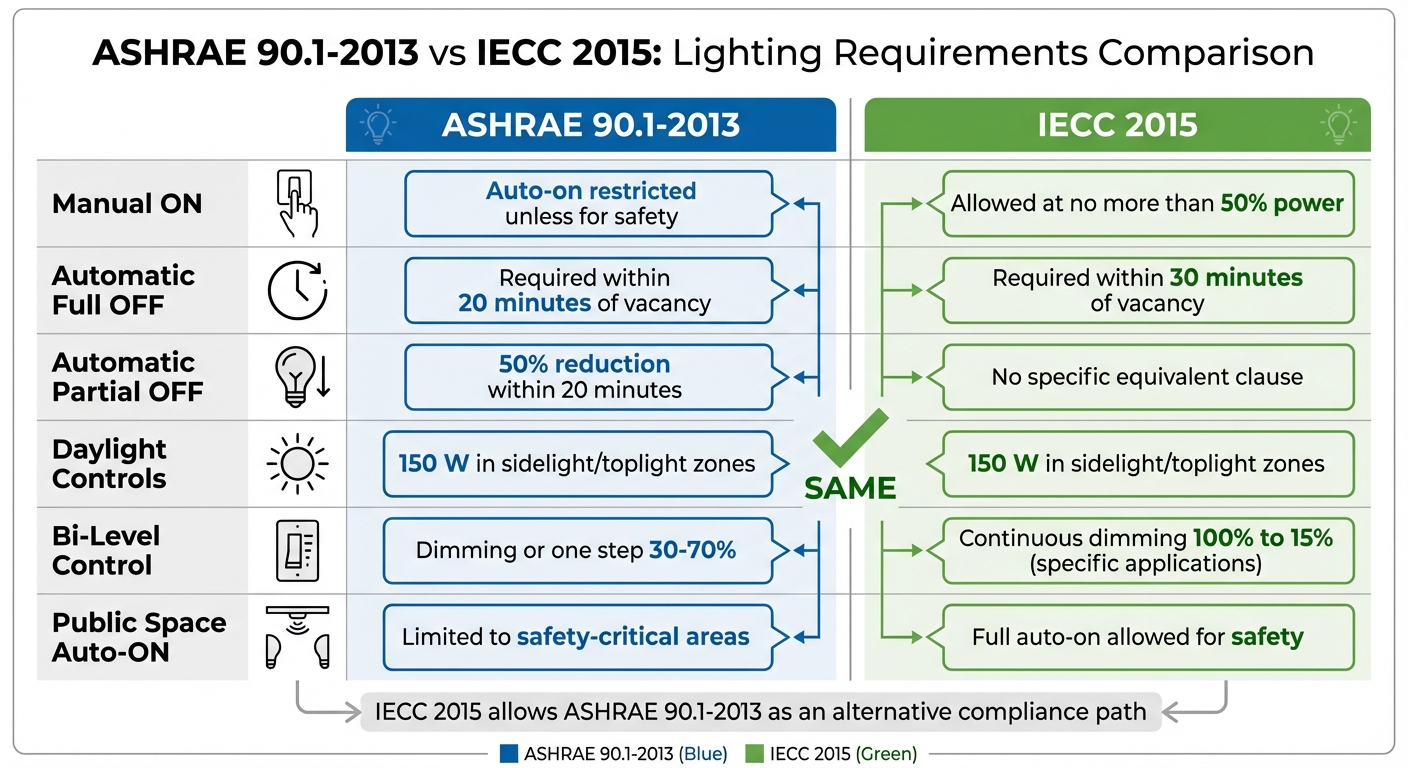
ASHRAE 90.1-2013 vs IECC 2015 Lighting Requirements Comparison
This breakdown highlights the key differences between ASHRAE 90.1-2013 and IECC 2015 in lighting design and retrofit standards. Both aim to cut energy use but differ in their approaches to timing, manual controls, and compliance options. Notably, IECC 2015 allows ASHRAE 90.1-2013 as an alternative compliance path, giving designers flexibility to choose the standard that aligns best with their project goals. Knowing these differences is essential for selecting retrofit strategies that balance performance and compliance.
ASHRAE 90.1-2013 establishes LPD thresholds, such as allowing spaces with 0.89 W/ft² or less (using HID lighting) to skip automatic partial OFF if they achieve a 30% power reduction within 20 minutes. IECC 2015 mirrors these baseline power allowances but adds stricter dimming requirements for institutional spaces. For example, IECC mandates continuous dimming in certain applications, raising the bar for compliance compared to ASHRAE's simpler bi-level controls.
The two standards also diverge in their control requirements. ASHRAE 90.1-2013 mandates that lighting in unoccupied spaces shuts off within 20 minutes, while IECC 2015 allows up to 30 minutes. Additionally, ASHRAE restricts automatic ON functionality to safety needs, whereas IECC permits manual ON at up to 50% power and allows full automatic ON in safety-critical public spaces.
For a quick overview, here’s a comparison table:
| Feature | ASHRAE 90.1-2013 | IECC 2015 |
|---|---|---|
| Manual ON | Auto-on restricted unless for safety | Allowed at no more than 50% power |
| Automatic Full OFF | Required within 20 minutes of vacancy | Required within 30 minutes of vacancy |
| Automatic Partial OFF | 50% reduction within 20 minutes | No specific equivalent clause |
| Daylight Controls | 150 W in sidelight/toplight zones | 150 W in sidelight/toplight zones |
| Bi-Level Control | Dimming or one step 30-70% | Continuous dimming 100% to 15% (specific apps) |
| Public Space Auto-ON | Limited to safety-critical areas | Full auto-on allowed for safety |
IECC 2015 takes a more stringent approach by requiring continuous dimming from 100% to 15% in spaces like classrooms, laboratories, and offices. This is a step beyond ASHRAE's bi-level control requirements, which are less demanding. These distinctions shape how each standard influences lighting design, helping professionals make informed decisions when planning retrofits.
Understanding retrofit triggers is crucial to keeping project costs and timelines on track. Under ASHRAE 90.1-2022, interior alterations that exceed 2,000W must comply with both lighting power density limits and mandatory control requirements. For projects staying under this threshold, compliance can be achieved by ensuring the new system uses at least 50% less wattage than the original. These smaller projects only require manual local controls and automatic shutoff systems.
IECC 2015 takes a slightly different approach, allowing compliance through ASHRAE 90.1-2013 as an alternative pathway. For exterior retrofits, replacing more than 10 luminaires or 20 linear feet of fixtures triggers full compliance. This includes occupancy sensors that reduce power usage by at least 50% within 15 minutes of vacancy.
Energy audits are essential for determining the right compliance strategy for your building. A professional audit evaluates the existing connected load, assesses space dimensions for required controls - like occupancy sensors in open offices larger than 300 sq. ft. - and determines whether daylight-responsive controls are necessary. Notably, ASHRAE 90.1-2022 has reduced the daylight control threshold from 150W to 75W, meaning more spaces now require these systems. These audits provide a clear roadmap for retrofits, ensuring accurate project planning and compliance with both ASHRAE and IECC standards.

Luminate Lighting Group simplifies the process of meeting retrofit standards with expert energy audits and tailored solutions. Our team thoroughly examines your lighting infrastructure to identify the most cost-effective compliance strategy. By reviewing wattage thresholds, space layouts, and control requirements, we determine whether your project falls under the 2,000W rule or qualifies for the simplified 50% reduction pathway. This proactive approach helps avoid unexpected issues during the project and ensures compliance with either ASHRAE or IECC standards from the start.
We specialize in hybrid control systems that combine the reliability of wired controls with the flexibility of wireless sensors. This method is especially effective for buildings constructed between 1960 and 1999. For example, we might recommend wired controls in utility areas, like restrooms, for cost efficiency, while using wireless sensors in open spaces. A great example of this approach is the Swexan Hotel in Dallas (2025), where occupancy sensors and daylight overrides were implemented to prevent false triggers while achieving energy efficiency goals. Additionally, our photometric designs and fixture specifications not only ensure code compliance but also help clients take advantage of utility rebates and 179D tax deductions, turning regulatory challenges into financial benefits.
When deciding on a standard, start by considering what your local jurisdiction has adopted. Across the U.S., the IECC is the most commonly enforced commercial code by states and local governments. Your building type is another key factor - ASHRAE 90.1 applies to nearly all buildings except low-rise residential (three stories or fewer), while the IECC provides distinct chapters for residential and commercial structures. This decision forms the groundwork for determining the most effective retrofit strategy.
For complex projects like hospitals, data centers, or large office buildings, ASHRAE 90.1's detailed requirements are often more suitable. On the other hand, smaller facilities - which make up 71% of U.S. commercial space at 10,000 sq. ft. or less - can take advantage of the IECC's simpler and more cost-efficient prescriptive pathways. If your goals include meeting ambitious energy efficiency benchmarks, qualifying for utility rebates, or securing 179D tax deductions, the regularly updated ASHRAE 90.1 may provide more defined options for achieving them.
To simplify these challenges, Luminate Lighting Group offers comprehensive support by conducting energy audits and identifying which standard strikes the best balance between energy efficiency and installation costs. We assess your building’s type, existing systems, and local code requirements to craft solutions that align with regulations while maximizing financial benefits. Whether tackling a historic renovation with wireless controls or a new construction project integrating HVAC and lighting systems, we ensure your upgrade aligns with the most suitable standard from the outset.
With over half of U.S. commercial buildings built between 1960 and 1999, retrofitting to meet modern standards can be a daunting task. Our expertise in hybrid control systems, photometric design, and code compliance helps address these challenges. By improving energy efficiency, enhancing lighting quality, and supporting long-term goals, we aim to make retrofitting a smoother, more rewarding process.
When it comes to energy codes, what applies will depend on where you're located. Many cities in the U.S. use the International Energy Conservation Code (IECC) as their main standard. However, they often allow compliance with ASHRAE 90.1 as an alternative. If your city has specifically adopted ASHRAE 90.1, then that standard becomes the one to follow. To be sure, check with your local government or building authority to confirm which code is currently enforced for lighting compliance.
Lighting retrofits require full code compliance when they align with updated energy efficiency and control standards, like those outlined in ASHRAE 90.1 or the IECC. This often means upgrading to LED systems, incorporating advanced control technologies, and completing both functional testing and thorough documentation to meet these regulations.
Modern energy codes, including the 2024 IECC, often require daylight dimming and occupancy sensors in specific spaces. For example, offices and parking garages must have occupant sensors, which detect activity and adjust lighting accordingly. Additionally, daylight-responsive systems are needed to modify lighting levels based on the amount of natural daylight present. These measures not only align with current standards but also enhance energy efficiency.


