.svg)
Fixture-level sensors and AI controls cut lighting energy, lower peak demand, and add predictive maintenance for commercial buildings.

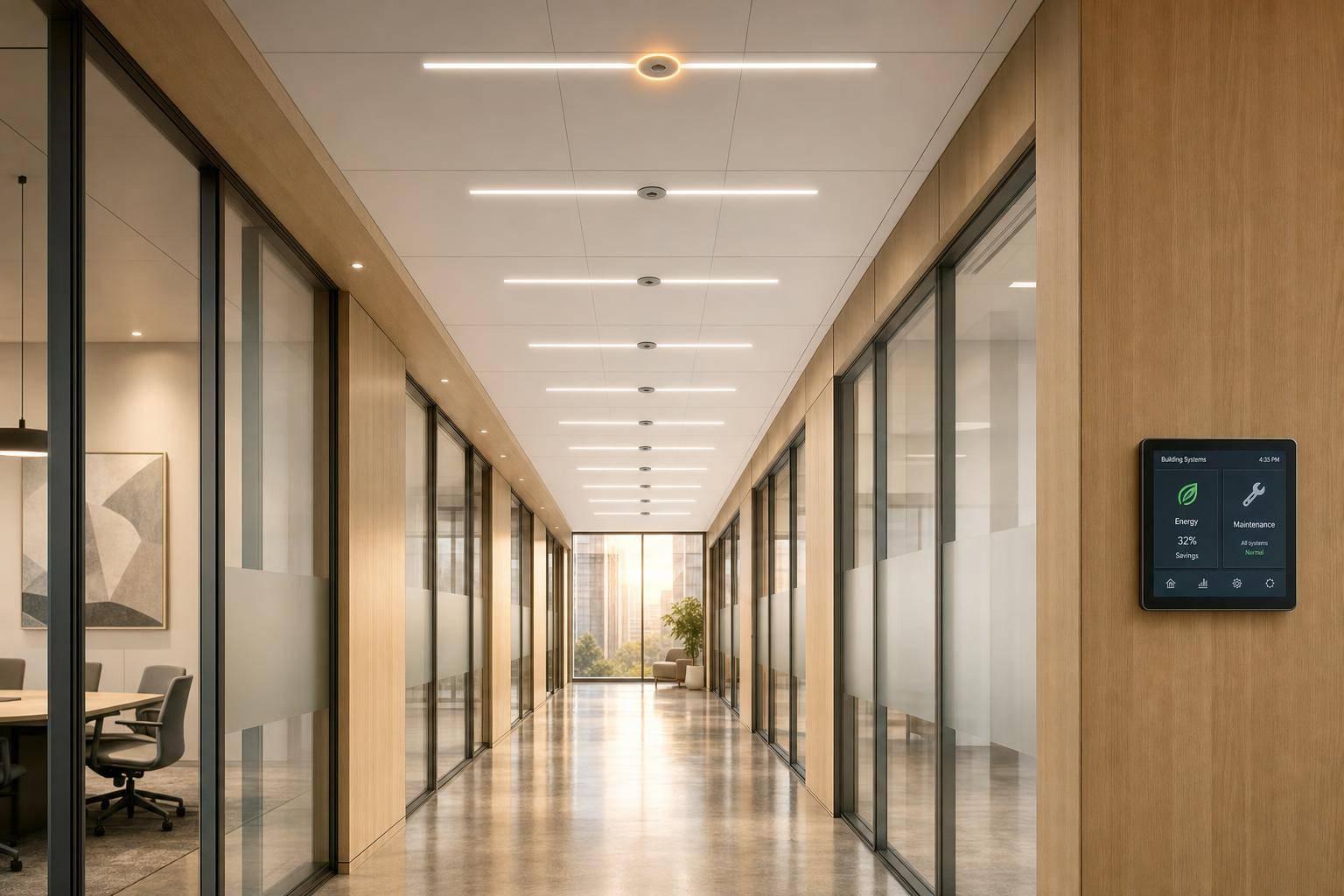
AI lighting in 2026 is about one thing: using fixture-level data to cut waste, lower peak demand, and make buildings easier to run. In many U.S. commercial spaces, these systems can trim lighting energy by 30% to 70%, and in some cases up to 85% when occupancy sensing, daylight harvesting, scheduling, and demand response work together.
If I had to boil the article down, I’d say this:
A few numbers stand out:
Here’s the core idea in plain English: lighting is no longer just about bulbs and fixtures. It’s becoming part of the building’s data system, where sensor inputs can also help with HVAC setbacks, space use tracking, demand response, and maintenance planning.
| Focus area | What matters in 2026 |
|---|---|
| Energy use | More savings come from controls, not just LED fixture swaps |
| Hardware | Fixture-level sensors, mmWave radar, dual-photodiode sensors, edge processing |
| Controls | Occupancy, daylight, task tuning, scheduling, follow-me logic |
| Integration | DALI-2, BACnet, IoT platforms, HVAC links |
| Business case | Lower kWh use, lower demand charges, rebates, 179D support |
| Risks | Bad sensor placement, weak tuning, poor network design, lock-in, cyber gaps |
| Best-fit spaces | Warehouses, conference rooms, perimeter offices, lobbies, schools, restrooms |
So if you’re planning a lighting upgrade in 2026, the short answer is this: start with a baseline, target the highest-use spaces first, and treat controls, integration, and commissioning as the main part of the project.
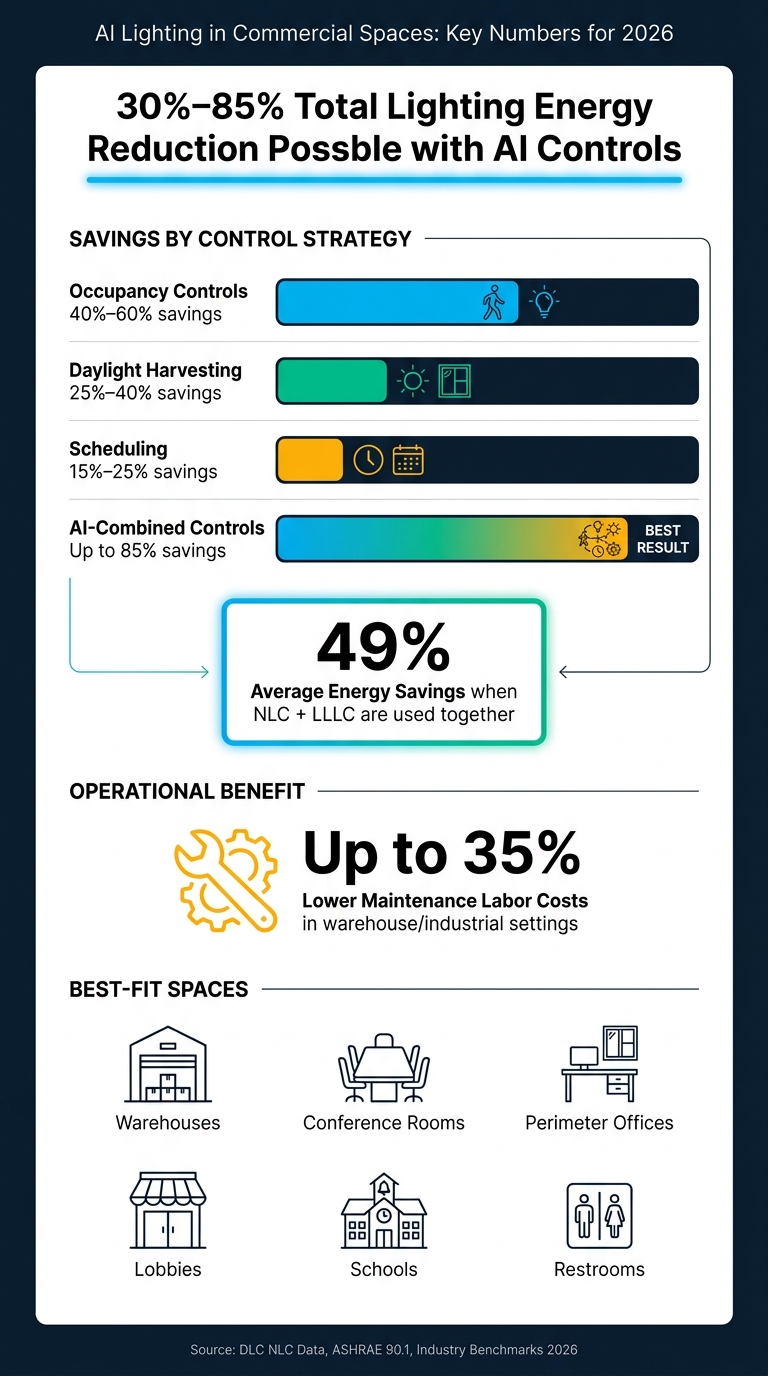
AI Lighting Energy Savings by Control Strategy (2026)
AI lighting works as a stack of sensors, controls, and software. To understand how it all fits together, start with the fixture itself.
The system begins at the fixture. Luminaire-Level Lighting Controls (LLLC) put sensors and controllers directly inside each fixture, which turns every light into its own control point. That’s a big shift from older networked setups, where one remote sensor handles several fixtures at once.
| Feature | Traditional Networked Controls | Luminaire-Level Lighting Controls (LLLC) |
|---|---|---|
| Control Relationship | One sensor manages multiple fixtures | Each fixture controls itself |
| Sensors | Remote, ceiling-mounted | Built into the fixture |
| Zoning | Fixed or hardware-based | Software-based and reconfigurable |
| Data Granularity | Group-level data | Fixture-level data |
| Wiring Complexity | Higher | Lower |
One major 2026 hardware update is mmWave radar sensing. It can detect occupancy even when something blocks the line of sight. That matters in places like warehouses, storage rooms, and busy work areas where people or equipment may be hidden from view.
Another upgrade is the use of dual-photodiode sensors. These sensors tell the difference between daylight and LED output, which helps the system avoid using more light than needed. The result is less wasted runtime and better dimming accuracy.
There’s also edge processing. Instead of sending every decision back through the network, the fixture can handle dimming on its own. That cuts latency and keeps the lights responsive, even if the network goes down.
Those fixture-level inputs feed the logic that decides when lights should turn on, dim, or stay off.
Sensor fusion combines occupancy, dwell time, daylight, temperature, humidity, and CO2 data into a single usage signal.
In plain English, the system doesn’t react to just one input. It looks at several signals at once, then makes a better call. For example, lights can dim during bright afternoon hours based on live daylight readings. Some systems also use follow-me logic, where lighting turns on ahead of workers or forklifts as they move through a space.
The energy impact can be huge:
That decision layer becomes much more useful once it connects with the rest of the building.
Integrated lighting can share data with BMS, HVAC, and energy platforms through open protocols like DALI-2 and BACnet.
DALI-2 supports up to 512 addressable nodes per line, compared with the original 64-device limit. That makes it a good fit for larger commercial and industrial facilities.
Open APIs can send lighting data into building IoT platforms, where it can be used for occupancy tracking, CO2 monitoring, asset movement, and foot-traffic analytics. So lighting data doesn’t just control lights. It can also help with HVAC control, analytics, and fault detection.
A simple example: if lighting data shows a zone is empty, the building can trigger HVAC setbacks in that area. That kind of cross-system response is where connected lighting starts to feel less like a utility and more like part of the building’s nervous system.
Once lighting joins the building network, security has to be part of the plan. Connected systems need cybersecurity controls that align with ANSI/UL 2900-1, IEC 62443, or ISO 27001. Check compliance before procurement.
Once sensor fusion and edge controls are in place, the 2026 focus shifts to what AI does with that data: cut waste and tighten day-to-day operations.
The biggest change in 2026 is simple: lighting no longer runs on fixed schedules. AI now adjusts light output by zone, occupancy, daylight, and tariff windows, which cuts wasted runtime. Put plainly, empty areas don't stay lit just because the clock says they should.
In high-bay warehouses and open commercial spaces, follow-me logic pre-lights the next aisle as workers or forklifts move through it. That helps with safety and reduces visual fatigue. In offices, AI uses daylight forecasts and sensor inputs to adjust light levels as conditions shift during the day.
AI isn't just trimming energy use. It's also making lighting better to work under.
In 2026, AI systems adjust color temperature and intensity based on time of day and the task at hand across offices, schools, warehouses, and municipal spaces.
Task tuning is a big part of that. Instead of running fixtures at full power by default, the system sets the top light output to match what the space actually needs. That means less glare, longer driver life, and better visual comfort.
Lighting systems are also changing how maintenance teams work. In 2026, AI tracks each fixture all the time. With bidirectional DALI-2 data, fixtures can send driver temperature spikes, battery faults, and runtime data to a central dashboard in real time.
That gives maintenance teams a chance to plan ahead. They can schedule batch replacements during planned downtime instead of dealing with failures in the middle of a shift. In warehouses and industrial sites, that means less disruption and maintenance labor costs that can drop by up to 35%.
AI lighting systems also help facilities react to utility demand-response events. During peak periods, the system can shed load on its own, which helps cut demand charges.
The DLC NLC v5.2 standard, released in June 2026, adds stronger lighting-HVAC integration and reporting for utility verification. That gives facilities a clearer way to tie lighting performance data to building management targets and incentive requirements.
These controls matter most when they lead to lower bills and demand cuts you can actually verify.
Once the controls are in place, the next step is simple: figure out what they give back in energy, cost, and day-to-day operations.
AI lighting creates business value in three main ways: it cuts energy use, lowers demand charges, and gives teams better operating data.
Facilities that combine Networked Lighting Controls (NLC) with Luminaire-Level Lighting Controls (LLLC) see an average of 49% energy savings. Most of that comes from stacking control strategies together, such as occupancy sensing, daylight harvesting, task tuning, and demand response. The dollar impact depends on the building type and the control setup.
These systems can also trim lighting loads during peak utility demand periods. That matters for two reasons. It can help support grid stability, and it may qualify the site for utility incentives.

IECC and ASHRAE 90.1 already steer most commercial projects toward occupancy sensing and daylight-responsive controls. So in many cases, better lighting controls aren't just a nice add-on. They're part of the code path.
On the rebate side, 2026 utility programs are putting more attention on connected systems and DLC-qualified advanced controls, not just basic LED retrofits. Incentives may include:
To keep rebate eligibility intact, check that every networked control component appears on the DesignLights Consortium (DLC) Qualified Products List. It also helps to get utility pre-approval before installation starts, since many programs have limited funding.
Well-documented lighting upgrades may also support 179D tax deduction opportunities. Detailed audits, fixture schedules, and code-based lighting design help set the baseline data needed for rebate applications and 179D filings.
The only way to prove business value is to measure it.
Before the upgrade, set a baseline for total kWh, kWh per square foot, runtime by zone, occupancy patterns, demand peaks, maintenance call frequency, and light level consistency. After installation, track those same metrics and compare the results.
| Basic LED Retrofit | LED + Standard Controls | LED + AI-Driven Controls | |
|---|---|---|---|
| Data Visibility | None or limited | Basic runtime logs | Real-time fixture-level analytics and building IoT data |
| Savings Potential | Medium - wattage reduction only | High - sensing and scheduling | Highest - continuous optimization |
| Operational Insight | Reactive - complaint-driven | Scheduled inspections | Utilization data supports HVAC scheduling, cleaning, and space planning |
| Rebate/Incentive Potential | Standard rebates | Enhanced rebates | Higher rebates + demand response incentives |
AI systems can also surface occupancy and utilization data that helps shape HVAC scheduling, cleaning schedules, and space planning. That's a big part of the business case, especially in offices, warehouses, and other spaces where occupancy shifts over time.
That said, those results depend on clean baseline data and steady control tuning.
AI lighting can pay off, but the setup has to be done right. The strongest savings usually show up only when commissioning and tuning are handled with care. If the network is weak or the control tier doesn't fit the space, savings can slip away and new problems can show up.
If sensors are placed badly or calibrated the wrong way, the system gets occupancy wrong. That can mean lights staying on in empty rooms or dimming while people are still working. Poor BMS connections can also break occupancy-based HVAC setbacks and analytics. And when controls don't line up with how people actually use a space, performance drops fast.
The fix is pretty simple in theory, even if it takes work in practice: commission before go-live, then retune once real occupancy data starts coming in.
Architecture matters too. A centralized setup creates one clear weak spot. If that controller goes down, the whole network can go with it. Distributed or mesh designs spread control logic across devices, so one failed node doesn't knock everything offline.
Connected lighting systems are still network devices. That means poor network security can lead to downtime, data loss, and control problems. A smart move is to separate the lighting network from the corporate data network. If one device gets compromised, segmentation helps contain the damage.
Network choice also comes with tradeoffs:
There's also the vendor question. If you want clean audits later and more freedom when buying or upgrading, check for open protocols and standardized reporting. That helps lighting data flow into the BMS without a mess and makes it easier to verify savings over time.
Not every space needs AI. In places with steady, predictable use, extra control layers may not earn their keep. Restrooms, storage rooms, and small private offices often work well with basic occupancy sensors, timers, and scheduled controls.
Sometimes the simple option does enough. Scheduling by itself can reduce lighting energy by about 24%. In lower-complexity spaces, that may cover the need without adding extra system burden.
A good rule of thumb is to save advanced controls for spaces where behavior changes a lot, like large areas, high-traffic zones, or rooms with many uses. That's why sizing the control approach space by space should be the first planning call.
Once the tradeoffs are understood, planning starts with a hard baseline. In plain terms, that means documenting every fixture, wattage, operating hours, and current foot-candle levels. It also means checking occupancy patterns in intermittent-use spaces like restrooms and conference rooms, and noting ambient light levels in areas where daylight harvesting or task-level dimming may help.
That audit is where the project stops being an idea on paper and starts becoming a control plan. If you skip this step, you're mostly guessing. If you do it well, you can match the lighting setup to how the building is used day to day.
Not every part of a facility will pay back at the same rate. Start with the areas that have the biggest performance gap and the most operating hours. Good first-stage candidates include restrooms, conference rooms, perimeter offices, lobbies, warehouses, and schools, where occupancy sensing, scheduling, and daylight harvesting can drive the fastest gains.
The key is simple: focus on the spaces where AI can adjust in the most useful ways. A warehouse with 16-hour lighting and no occupancy sensing should come before a fixed-schedule office. That's where the waste usually sits, and that's where smarter controls tend to do the most work.
After you pick the pilot spaces, check the controls package before procurement. A solid proposal should cover more than cost and fixture count.
| Question | Why It Matters |
|---|---|
| How will the system integrate with existing BMS and HVAC? | Lighting should coordinate with other building systems for whole-facility efficiency |
| What mix of dimming, occupancy sensing, scheduling, daylight harvesting, and task-level dimming is included? | Shows whether the design covers base and advanced control layers |
| Can the system learn occupancy patterns and forecast daylight availability? | AI should adjust to actual usage, not rely only on fixed settings |
| What does commissioning include, and how will AI logic be tuned after installation? | The system needs to reflect actual occupancy patterns |
| Does the system support demand response? | Helps reduce peak loads and can support utility incentives |
| What analytics and predictive maintenance tools are available? | Fixture-level data helps spot issues before failures occur |
| What cybersecurity protections are in place? | Connected lighting systems need clear network security safeguards |
Also ask whether the dashboard gives fixture-level data or only zone-level summaries. That detail matters more than it may seem. Centralized visibility is what helps a system improve over time, whether you're managing one site or a multi-site portfolio.
When those choices line up, AI lighting delivers its best return. In 2026, AI lighting is no longer just a controls upgrade. It's becoming a core part of how commercial buildings manage energy, maintenance, and occupant experience.
The priorities that matter most right now are adaptive energy optimization, fixture-level analytics, grid-responsive control, and tighter integration with building systems and energy codes. The projects that perform well tend to start the same way: with a solid baseline, clear KPIs, and a retrofit plan built around measurable goals. Results still come down to baseline quality, target selection, and commissioning.
Your building may need AI-driven lighting controls if occupancy changes a lot, work hours move around, or seasonal daylight shifts make fixed schedules a poor fit.
AI isn’t required for compliance. But it can help with predictive maintenance, automated tuning, and real-time lighting changes based on daylight and occupancy.
If you’re not sure whether it makes sense for your space, Luminate Lighting Group can review your facility through an energy audit and on-site assessment.
Start with a lighting audit to set a baseline. Write down each fixture’s type, wattage, age, and the controls it uses today.
Then measure light levels, energy use, and circuit layout. It also helps to review at least 30 days of energy data, utility bills, and your building layout so you can see how people use the space and where traffic tends to move.
In commercial spaces, AI and smart lighting systems usually pay for themselves in 1 to 4 years.
A lot of IoT-enabled systems land in the 18 months to 3 years range. And in some cases, high-performing setups can return costs in as little as 45 to 60 days.
The timeline comes down to a few things: upfront installation costs, occupancy patterns, and how deeply the system is tied into the building. Luminate Lighting Group can help shorten the payback period by applying utility rebates and the 179D tax deduction.


