.svg)
2026 179D rules for LED retrofits: construction-start deadline, 25% energy-model threshold, labor tiers, and required documentation.

If your LED retrofit did not start by June 30, 2026, §179D is likely off the table. That is the main takeaway.
If I were planning or reviewing a 2026 lighting project, I would focus on four things right away:
Here’s the short version: placed in service and construction start are not the same thing. I would claim the deduction when the system is installed and running, but I would use the construction start date to lock in the standard used for the model. That timing point can decide whether the project qualifies at all.
For lighting retrofits, the model must show at least 25% energy cost savings versus the ASHRAE baseline, and higher savings can move the deduction closer to the top end. LEDs alone may qualify, but controls like occupancy sensors and daylight controls often help push savings higher.
| Item | What I’d check |
|---|---|
| Deadline | Construction started by 6/30/2026 |
| Claimant | Owner, or designer for some tax-exempt properties |
| Minimum threshold | 25% modeled energy cost savings |
| Deduction range | $0.59-$5.94 per sq. ft. |
| Main records | Start-date proof, specs, model, third-party certification |
Bottom line: if I were reviewing a project file today, I would first confirm the start-date record, then verify the energy model, labor tier, square footage, and certification file before looking at tax filing details.
§179D is open to owners of qualifying commercial buildings, including offices, warehouses, retail spaces, industrial buildings, and multifamily buildings that are four stories or taller. Tax-exempt buildings play by a different rule, which shifts the claim to the designer in certain cases.
For tax-exempt public buildings like schools and municipal facilities, designers can claim §179D.
After you know who can claim the deduction, the next issue is timing. For the 2026 timing test, the date that matters is when construction starts.
That start date sets the applicable ASHRAE Standard 90.1 version, which is generally the version in effect up to two years earlier. In plain English, starting before July 1, 2026 can lock in the right standard even if the installation wraps up later. So yes, the work can finish after June 30, 2026, as long as construction began before then.
These two dates do different jobs, and mixing them up can cause problems.
One date affects when you claim the deduction. The other affects which efficiency standard applies.
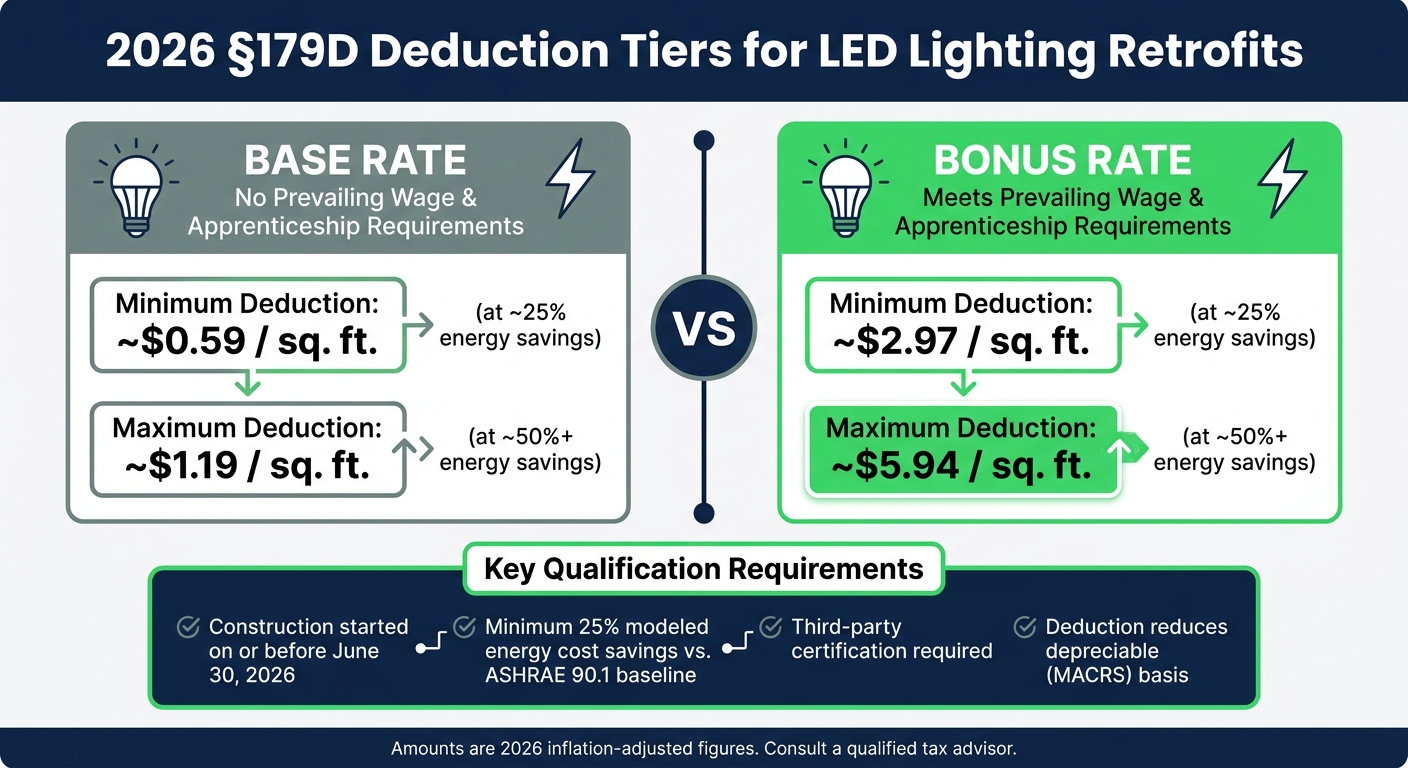
2026 §179D Deduction Tiers: Base Rate vs. Bonus Rate for LED Retrofits
Once the timing rules are clear, the next step is simple: does the lighting retrofit pass the savings test?
Interior lighting systems can qualify, and the deduction is tied to modeled cost savings compared with the ASHRAE 90.1 baseline.
That point matters. Qualification is based on energy modeling, not self-reporting. To get any deduction in 2026, the model must show at least a 25% reduction in cost savings, and the deduction goes up as savings move past that mark. A lighting-only retrofit can still qualify.
The 2026 deduction amounts are adjusted for inflation and split into two tiers based on whether the project meets prevailing wage and apprenticeship rules. For planning, the big issue is how much that deduction shifts the numbers.
| 2026 §179D Deduction Tier | Min. Deduction (~25% Savings) | Max. Deduction (~50%+ Savings) |
|---|---|---|
| Base rate (No Prevailing Wage) | ~$0.59 / sq. ft. | ~$1.19 / sq. ft. |
| Bonus rate (With Prevailing Wage) | ~$2.97 / sq. ft. | ~$5.94 / sq. ft. |
That gap is hard to ignore. A project that meets labor rules can land at a much higher deduction, so it makes sense to look at compliance early instead of treating it like a last-minute box to check.
Controls often matter just as much as fixture efficiency. LED fixtures can produce large savings on their own, but occupancy sensors, daylight harvesting controls, and lighting controls and design changes can push modeled savings higher and increase the deduction.
This is usually where planning makes or breaks the result. Getting the energy model done before installation, not after, helps cut down on surprises when filing time comes.
Once you meet the construction-start deadline, lock the ASHRAE baseline before you finalize the energy model. Use the ASHRAE 90.1 version tied to the construction start date. That baseline controls the energy model used to size the deduction.
After that deadline is set, the next job is simple in theory but important in practice: turning the lighting model into a tax number.
§179D lowers depreciable basis, which means future MACRS deductions go down. That change needs to be built into the ROI model.
Start with the exact square footage. Then build the forecast around the numbers that drive the project:
Subtract utility rebates from net project cost. Then use the forecast to compare upfront cost, tax benefit, utility savings, and payback timing before approval. It also helps to review the forecast with operations, finance, and tax teams before installation.
The final step is gathering the records that support the model and the deduction claim.
Once your savings model is in place, paperwork stops being a side task. It becomes the thing that separates a tax deduction that looks good on paper from one you can stand behind.
Good records don’t just support the tax claim. They also back up the lighting ROI story.
Before installation, gather:
After the model is complete, lock down the file with both pre-installation and post-installation evidence. A qualified third-party certifier must verify that the project meets the savings threshold for the right deduction tier. If the property is tax-exempt, confirm how the deduction will be allocated between the owner and designer before filing.
It also helps to assign ownership early, so nothing slips through the cracks:
With the project file complete, facility managers can shift from basic eligibility checks to filing support. Since eligibility depends on the construction-start date, keep those start-date records in the project file.
On larger facilities, the deduction can have a clear effect on project payback. It’s also worth checking older projects for missed claims. §179D claims can be made for qualifying work completed as far back as 2006.
Keep §179D in your capital-planning model for future LED and controls upgrades.
Keep detailed project records. The rules don’t point to one single legal document that proves a construction start date. Instead, records like invoices, equipment specifications, and energy analysis reports can help support 179D eligibility.
To stay compliant, work with qualified professionals who can handle the documentation, permitting, and third-party certifications needed to confirm your project timeline and energy savings.
Yes. A lighting-only retrofit can qualify for a partial 179D deduction, even though full-building deductions call for work across lighting, HVAC, and the building envelope.
To qualify, the retrofit must show at least a 25% energy reduction compared to the applicable ASHRAE 90.1 baseline. Installation alone isn't enough. The project also needs performance verification that meets IRS compliance standards.
Section 179D can improve project payback by cutting the net cost of energy-efficient lighting upgrades. Since it lowers taxable income, it can shrink the payback period when you pair it with energy savings and utility rebates - sometimes to less than two years.
To get the most from it, the project needs to hit the required energy reduction target, usually 25% or more compared with the ASHRAE 90.1 baseline. If the project also meets prevailing wage and apprenticeship rules, the deduction can be higher.


